A Legal Guide for Victims Injured in a Semi-Truck Accident in Illinois

A Legal Guide for Victims Injured in a Semi-Truck Accident in Illinois

If you’re dealing with serious injuries, a totaled vehicle, lost income, and a flood of calls from insurance adjusters, all while trying to understand what your rights actually are, you’re in the right place. 

What most people do not realize (until it’s too late) is that a semi-truck accident claim operates under a completely different legal framework than a standard car accident. 

Federal regulations, shared responsibility (who’s liable?), filing deadlines, and evidence that’s critical to your case. We’ll go through each so you can make informed decisions about your next steps.

More Than One Company May Be Responsible for Your Injuries

This is one of the most important differences between a truck accident claim and a car accident.

When a car hits you, liability typically points to one driver. A semi-truck crash is different. Potential defendants can include: 

  • Truck driver

  • Trucking company

  • Vehicle maintenance provider

  • A third-party cargo loading contractor, or; 

  • Manufacturer of a defective component

Each of these parties may carry separate legal responsibility depending on what the investigation uncovers.

Is the Trucking Company Liable?

Under Illinois law, a trucking company can be held responsible for an accident caused by its driver even when the company itself made no error during the crash itself. 

This is called "vicarious liability.” The company is legally accountable for the actions of its employee while on duty. Beyond that, carriers may face additional direct claims: 

  1. Negligent hiring if the driver had a disqualifying record that a background check would have caught

  2. Negligent retention if a dangerous pattern emerged during employment and the company kept using the driver anyway

  3. Negligent maintenance if the vehicle failed to meet the roadworthy standards required by 49 CFR 396

Each theory requires different evidence, which is why a thorough investigation matters before any claim is filed.

Two Sets of Rules Apply to Every Semi-Truck on Illinois Roads

Every commercial truck operating in Illinois is subject to two overlapping bodies of law simultaneously.

The federal layer is administered by the Federal Motor Carrier Safety Administration (FMCSA), a U.S. Department of Transportation agency established by the Motor Carrier Safety Improvement Act of 1999. FMCSA regulations, compiled in Title 49 of the Code of Federal Regulations, set mandatory standards for driver qualifications, hours behind the wheel, vehicle maintenance, cargo securement, drug and alcohol testing, and minimum insurance coverage. 

These are not voluntary guidelines. Violations carry legal consequences for drivers and carriers alike. The state layer adds Illinois-specific requirements under the Illinois Vehicle Code, 625 ILCS 5/.

State law governs Commercial Driver's License (CDL) standards, intrastate weight limits, and traffic enforcement within Illinois borders. When a crash occurs, investigators and attorneys examine both sets of rules. 

A violation of an FMCSA regulation can establish what lawyers call "negligence per se", a legal term meaning the violation itself is treated as proof of fault, without requiring additional evidence that the conduct was unreasonable. 

In plain terms: if a truck driver exceeded legal driving-hour limits before your crash, that violation can be used directly against the driver and carrier in your claim.

Evidence Collection for Truck Accident Cases

Commercial trucks generate a paper and digital trail that ordinary vehicles do not. That trail is also subject to being overwritten, deleted, or destroyed; sometimes within days of a crash.

The Electronic Logging Device (ELD) mandate, which took effect in December 2017 and is codified at 49 CFR 395, requires commercial trucks to automatically record driving hours electronically. These records show exactly how long the driver had been on the road before your crash and whether they exceeded legal limits. 

Unlike the paper logbooks drivers once filled out by hand, ELD data is difficult to falsify, but it is not retained forever. The full evidentiary record in a trucking case can include the following: 

  • Driver's qualification file

  • Vehicle maintenance logs

  • Drug and alcohol testing history

  • Pre- and post-trip inspection reports

  • Cargo manifests and load securement records

  • The carrier's Department of Transportation (DOT) safety rating and Compliance, Safety, Accountability (CSA) scores 

  • The truck's electronic control module (commonly called the black box) which captures speed, braking, and engine data at the moment of impact.

Federal regulations set minimum retention periods for these records, but those periods are not indefinite, and they do not protect records that are overwritten in the ordinary course of business. 

A "legal hold demand" is a formal written notice sent to the carrier and its insurer requiring them to preserve all relevant evidence. Sending one promptly after a crash is one of the most important early steps in a trucking case, and it is not something an unrepresented victim has a practical way to do on their own.

If you need help collecting evidence, or have trouble navigating against insurance companies, you can speak to a semi-truck accident lawyer today.

Be Wary Before Accepting Insurance Settlements

Commercial motor vehicles are required to carry substantially more liability coverage than private passenger vehicles.

Under 49 CFR 387, motor carriers transporting general freight must maintain a minimum of $750,000 in liability coverage. For hazardous materials, that floor rises to $5,000,000. These minimums reflect the scale of damage a vehicle weighing up to 80,000 pounds can cause at highway speeds. 

Injuries in serious trucking crashes frequently include traumatic brain injuries, spinal cord damage, multiple fractures, long-term disability, and wrongful death, losses that can far exceed what standard auto insurance is designed to cover.

Higher policy limits do not mean the money flows easily. Carriers employ experienced claims teams whose job is to minimize payouts.

An early settlement offer from a carrier's insurer, especially one that arrives in the first days after a crash, is not an act of goodwill. It is a business calculation made before your injuries are fully documented, before liability has been investigated, and before anyone knows what the case is actually worth. Accepting it closes your claim permanently. Once signed, there is no going back regardless of how your injuries develop.

The Filing Deadline in Illinois

Illinois gives injured victims two years to file a personal injury lawsuit.

735 ILCS 5/13-202 requires personal injury actions to be filed within two years of the date the injury occurred. Wrongful death claims follow a separate statute, 740 ILCS 180/2, which runs two years from the date of death rather than the date of the crash itself. 

Two years can feel like a long window until you account for what actually has to happen before a trucking case is ready to file: identifying all defendants, sending evidence preservation demands, gathering and analyzing federal regulatory records, obtaining ELD data, consulting with accident reconstruction or medical experts, and fully documenting the scope of your injuries and losses.

In practice, waiting significantly reduces your options.

What to Do After a Semi-Truck Accident in Illinois

Below is an outline of the steps we encourage you to take in chronological order:

  • Your first priority is medical care. Go to the emergency room or urgent care even if you feel relatively okay. Some of the most serious injuries from high-force collisions, including traumatic brain injuries and internal bleeding, do not produce obvious symptoms immediately. A medical record created on the day of the crash establishes a baseline that becomes important evidence later. 

  • Follow through on all recommended follow-up care. Gaps in treatment are one of the first things defense attorneys use to argue that your injuries were not as serious as claimed.

  • Document everything you can access at the scene. And in the days that follow. Take photographs of both vehicles, the road, any skid marks, the truck's license plate and DOT number, the driver's Commercial Driver's License (CDL), and any visible injuries. 

  • Get the names and contact information of witnesses. Write down your own account of what happened as soon as you are able, while the details are still clear. If the police responded to the scene, obtain a copy of the crash report. These materials form the foundation of a claim before any formal investigation begins.

  • Do not speak with the trucking company's insurance adjuster without legal representation. Adjusters are trained to gather statements that can be used to reduce or deny your claim. You are not required to give a recorded statement, and doing so early(before you know the full extent of your injuries or understand who is liable) can significantly harm your position. The same applies to signing any documents, including medical records releases that go beyond your treating providers.

Talk to a Chicago Truck Accident Lawyer

Wojcik Law represents individuals injured in semi-truck and commercial vehicle accidents throughout Illinois, with offices serving Chicago and the southwest suburbs. 

For additional information on the cases we’ve worked through over the years, you can read about them here.

You can schedule a consultation to review your situation, explain your rights, and discuss whether a formal investigation makes sense given the circumstances of your crash. Alternatively, you can reach us at 708-424-2121. There is no fee unless your case results in a recovery.

What Injuries Are Covered by Workers' Compensation in Illinois?

If you've been injured at work, one of the first questions you're likely asking is whether your injury qualifies for workers' compensation benefits. 

The answer, in most cases, is yes, but understanding what injuries are covered by workers' comp in Illinois requires knowing how the law defines a compensable workplace injury.

Under the Illinois Workers' Compensation Act, nearly all injuries that occur in the course of employment are covered, regardless of who was at fault. This includes 

  • Equipment accidents

  • Occupational diseases

  • Sudden traumatic injuries like falls

  • Gradual injuries that develop over time such as repetitive stress injuries

At William S. Wojcik, Ltd., we have represented injured workers throughout Oak Lawn, Chicago, and the southwest suburbs for over 38 years. If you've been hurt on the job and are unsure whether your injury qualifies for benefits, understanding the scope of Illinois workers' compensation coverage is the first step toward protecting your rights.

How Illinois Workers' Compensation Coverage Works

Illinois workers' compensation is a no-fault insurance system designed to provide medical care and wage replacement to employees who are injured on the job. 

This means you do not need to prove that your employer was negligent or that the injury was anyone's fault. If the injury arose out of and occurred in the course of your employment, it is generally covered.

Key principles under the Illinois Workers' Compensation Act:

Arising out of employment: The injury must have a connection to your job duties or work environment. It does not need to be the sole cause, but your employment must be a contributing factor.

In the course of employment: The injury must occur while you are performing work-related tasks or during work hours in a location where your job requires you to be.

Employer liability is automatic: Illinois employers are required to carry workers' compensation insurance. If you are injured, your employer's insurance is responsible for covering your medical expenses and lost wages, regardless of fault.

There are very few exceptions to this rule. Most workplace injuries (whether they happen suddenly or develop gradually) fall within the scope of coverage.

Types of Injuries Covered by Workers' Comp in Illinois

Illinois workers' compensation law covers a broad range of workplace injuries and illnesses. Here are the main categories:

Acute Injuries

Acute injuries are sudden, traumatic events that occur at a specific time and place. These are the most commonly recognized workers' compensation claims.

Examples of covered acute injuries:

  • Burns, cuts, or lacerations

  • Falling objects striking a worker

  • Workplace assaults or altercations

  • Motor vehicle accidents during work duties

  • Lifting injuries (herniated discs, muscle strains)

  • Injuries from machinery or equipment malfunctions

  • Slip and fall injuries (fractures, sprains, head injuries)

If you were injured in a single incident while performing your job, it almost certainly qualifies for workers' compensation benefits.

Repetitive Stress and Overuse Injuries

Not all workplace injuries happen in one moment. Take for example, carpal tunnel syndrome. It doesn’t happen in an instant, but rather gradually over time. 

Repetitive stress/strain injuries develop over time due to repeated motions, prolonged physical strain, or continuous exposure to certain work conditions.

Examples of covered repetitive stress injuries:

  • Shoulder injuries from overhead work

  • Back injuries from chronic heavy lifting

  • Knee injuries from prolonged kneeling or standing

  • Tendonitis or bursitis (from repetitive lifting, reaching, or gripping)

  • Carpal tunnel syndrome (from typing, assembly line work, or tool use)

Repetitive stress injury workers' comp claims are fully covered under Illinois law, even though the injury may not have a specific date of occurrence. 

What matters is that the injury resulted from your work duties.

Occupational Diseases and Illnesses

Occupational diseases and illnesses are chronic, work-related illnesses that happen because of prolonged exposure to:

  • Physical strain

  • Hazardous substances

  • Environmental conditions

Unlike a slip and fall accident, occupational diseases aren’t acute. Inhaling harmful dust or gases over time, for instance, can lead to respiratory disease.

Illinois workers' compensation also covers illnesses and occupational diseases caused by workplace exposure or conditions.

Examples of covered occupational diseases:

  • Skin conditions from chemical or irritant exposure

  • Hearing loss from prolonged exposure to loud noise

  • Respiratory illnesses from poor air quality or toxic fumes

  • Lung diseases from asbestos, silica dust, or chemical exposure

  • Infectious diseases contracted through work (healthcare workers, first responders)

Occupational disease claims can be more complex because you may need to establish a clear link between your work environment and your illness. Medical evidence and expert testimony are also often required.

Aggravation of Pre-Existing Conditions

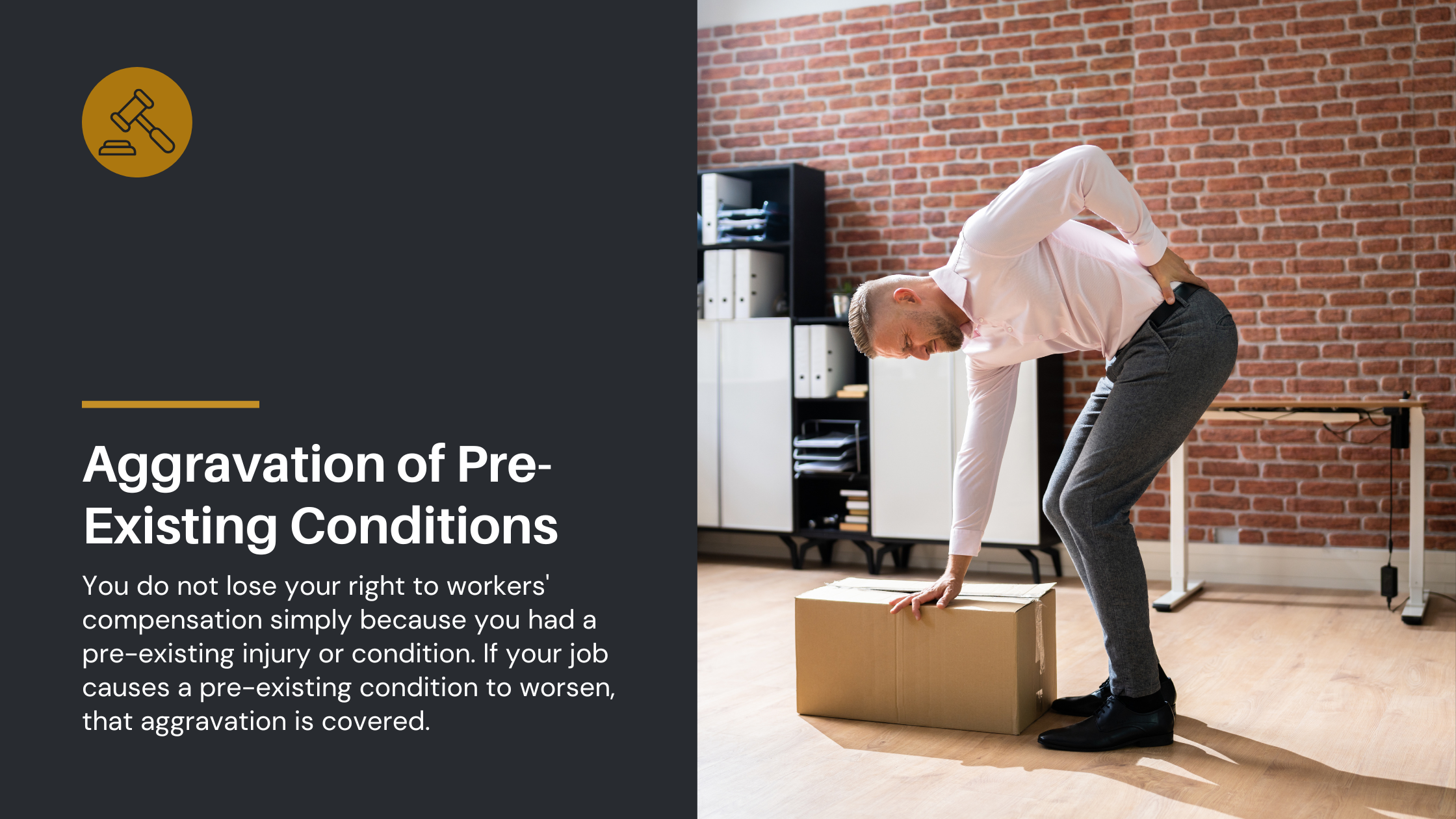
You do not lose your right to workers' compensation simply because you had a pre-existing injury or condition. If your job causes a pre-existing condition to worsen, that aggravation is covered.

Example: You have a prior history of lower back pain. While lifting heavy materials at work, you herniate a disc. Even though you had a pre-existing back condition, the work-related aggravation qualifies for workers' compensation benefits.

Illinois law recognizes that workers are taken as they are. Employers cannot deny coverage based on a pre-existing condition if the job contributed to making it worse.

Common Workers' Comp Injuries We Handle

At Wojcik Law, we represent Illinois workers with a wide range of injuries, including:

Back injuries: Herniated discs, lumbar strains, spinal injuries from lifting, falls, or repetitive motion. Back injury workers' comp claims are among the most common in Illinois.

Fractures and broken bones: From falls, vehicle accidents, or being struck by objects.

Head and brain injuries: Concussions, traumatic brain injuries from falls or workplace accidents.

Shoulder, neck, and arm injuries: Rotator cuff tears, frozen shoulder, nerve damage.

Knee and leg injuries: Torn ligaments, meniscus injuries, chronic joint damage.

Burn injuries: From chemical exposure, electrical accidents, or fire.

Amputations and crush injuries: From machinery or equipment accidents.

Repetitive motion injuries: Carpal tunnel, tendonitis, chronic pain conditions.

Hearing loss and respiratory conditions: From prolonged occupational exposure.

If your injury is not listed here, that does not mean it is not covered. Illinois workers' compensation law is broad, and most work-related injuries qualify for benefits.

What Injuries Are NOT Covered by Workers' Compensation

While Illinois workers' compensation covers most workplace injuries, there are a few exceptions every employee should be aware about:

Self-inflicted/self-harm injuries: Injuries caused intentionally by the employee are not covered.

Injuries caused by intoxication or drug use: If you were intoxicated or under the influence of illegal drugs at the time of the injury, your claim may be denied.

Injuries during horseplay or fighting: Injuries that occur while the employee is engaged in non-work-related activities, such as fighting or horseplay, may not be covered. 

Injuries outside the course of employment: If you are injured while not performing work duties, such as during a personal errand or social event unrelated to work, the injury may not qualify. Typically, injuries that happen outside of work or are non-work related, are classified as short-term disability.

Commuting injuries: Injuries that occur during a normal commute to or from work are generally not covered, unless you were performing a work-related task at the time.

If your claim has been denied based on one of these exclusions, it is important to consult with an attorney. Employers and insurers sometimes wrongly classify injuries as excluded when they are, in fact, covered.

What to Do If You're Injured at Work in Illinois

If you are injured on the job, taking the right steps immediately can protect your ability to receive benefits:

1. Report the injury to your employer immediately
Illinois law requires you to notify your employer of a workplace injury within 45 days. Delaying this notice can jeopardize your claim. Report the injury verbally and in writing if possible.

2. Seek medical treatment
Get medical care as soon as possible, even if the injury seems minor. Your employer or their insurance company may direct you to a specific doctor. Follow their instructions. However, you are allowed to choose your own doctor after the initial treatment.

3. Document everything
Keep records of the incident, your injuries, medical treatment, and all communication with your employer and the insurance company.

4. File a workers' compensation claim
Your employer should provide you with the necessary forms to file a claim. Filing a workers compensation claim can be done on your own or with legal help. For cases where you’re dealing with an occupational disease or complicated case, it’s best to contact a workers compensation attorney to ensure the claim is filed correctly and on time. 

5. Consult with a workers' compensation attorney
Insurance companies do not always act in your best interest. Most pressure you into settling for a lowball offer. An experienced workers comp attorney in Illinois can help you understand your rights, negotiate fair benefits, and represent you if your claim is disputed or denied.

How Wojcik Law Can Help with Your Workers' Comp Claim

Workers' compensation claims can be complicated, especially when dealing with serious injuries, disputed claims, or employer pushback. 

At William S. Wojcik, Ltd., we can help you:

  • Appeal denied claims

  • File your claim correctly and on time

  • Negotiate with insurance companies for fair compensation

  • Gather medical evidence and documentation to support your case

  • Determine whether your injury qualifies for workers' compensation

  • Represent you at hearings before the Illinois Workers' Compensation Commission

Our firm operates on a contingency fee basis, which means you pay nothing unless we recover benefits for you. Let us handle the legal process.

If you've been injured at work and have questions about what injuries are covered by workers' comp in Illinois, contact William S. Wojcik, Ltd. today. 

Or for a direct appointment, call 708-424-2121 for a free consultation. We serve clients throughout Oak Lawn, Chicago, Chicago Ridge, Bridgeview, Burbank, and the surrounding southwest suburbs. You have rights as an injured worker. Let us help you protect them.

How Much Do Workers’ Comp Attorneys Charge in Chicago? Fee Caps, Percentages, and What to Expect

In Chicago and throughout Illinois, workers’ compensation attorneys typically charge nothing upfront. 

They are paid on a contingency fee basis, meaning they only get paid if your claim is successful. Even then, their fee is capped by Illinois law and must be approved by the Illinois Workers’ Compensation Commission.

That distinction matters, especially if you’re already dealing with an injury, missed paychecks, and uncertainty about what comes next. Cost is often the first concern injured workers have, and understandably so. 

What you’ll learn from this guide: 

  • How workers’ comp attorney fees work in Chicago

  • What the Illinois law states about contingency fees

  • How much you have to pay to hire a Chicago workers comp lawyer

  • Why understanding the fee structure upfront can help you make a more confident decision

Why Cost Is the First Concern for Injured Workers

For many Chicago-area workers, whether in construction, warehousing, healthcare, manufacturing, or transportation, a  work injury can mean immediate income disruption. 

Medical appointments pile up. Employer communication changes. Insurance paperwork starts arriving, often without clear explanations.At that moment, the idea of hiring a lawyer can feel risky. Many of our clients mentioned they were initially worried about owing money they don’t have or that legal fees will take away from already limited benefits. 

This hesitation is common, and it’s one of the main reasons Illinois strictly imposes a tightly regulated fee system for workers’ compensation cases.

The Standard Fee Structure for Workers’ Comp Attorneys in Chicago (Contingency Fees) 

Workers’ compensation attorneys in Illinois do not bill by the hour and do not require retainers in most cases. Instead, they work on a contingency fee.

A contingency fee means:

  • The fee is taken from the recovery, not paid upfront

  • The attorney only gets paid if benefits are recovered

  • If the case is unsuccessful, attorney fees are typically not owed

This system is designed to make legal representation accessible to injured workers who may not be in a position to pay hourly legal rates while out of work.

Illinois Law and the 20% Fee Cap 

Illinois law places clear limits on how much a workers’ compensation attorney can charge.

Under the Illinois Workers’ Compensation Act, attorney fees are generally capped at 20% of the amount recovered, also known as the Statutory Fee Limit

The fees must also be reviewed and approved by the Illinois Workers’ Compensation Commission. Further, attorneys cannot charge excessive or unapproved fees.

This oversight exists to protect injured workers. 

Unlike other types of injury cases, workers’ compensation claims follow a structured system where attorney compensation is regulated, transparent, and subject to review.

How Attorney Fees Are Calculated in Real Workers’ Comp Cases

Attorney fees are typically calculated based on the benefits recovered through the claim. In practice, this means:

  • The fee is applied to wage replacement benefits, settlements, or awards

  • Medical treatment benefits are not usually reduced to pay attorney fees

  • The attorney’s payment is taken after benefits are secured, not before

Rather than focusing on a percentage alone, many workers find it more helpful to understand when fees apply and how the system is designed to prevent unexpected deductions.

Case Costs, Expenses, and What “No Upfront Cost” Really Means

Attorney fees and case expenses are not the same thing. In a workers’ compensation case, expenses can range from administrative to case-to-case evaluations. 

Generally…

  • Administrative filing costs

  • Medical record retrieval fees

  • Expert evaluations (when necessary)

In many cases, attorneys advance these costs during the claim. If the case is successful, those expenses can be reimbursed from the recovery. If not, firms often absorb them, but this is something you should discuss clearly with your workers compensation lawyer during a consultation.

Transparency at the beginning of a case is essential, and reputable workers’ compensation attorneys will explain both fees and expenses in plain language.

What Does 'No Win, No Fee' Mean for Injured Workers?

The phrase "no win, no fee" refers to the principle of contingency fee arrangements. 

It means that if your attorney does not secure a settlement or award for you, you will not owe them any fees. This model, as set by IWCC, provides peace of mind for clients, as it reduces the financial risk associated with pursuing a workers' compensation claim. 

Can Workers’ Comp Attorney Fees Exceed 20% (And When Does It Happen?)

Workers comp attorney fees can exceed 20% but in rare cases, and only through limited exceptions. 

Fees may exceed 20% in cases involving:

  • Appeals

  • Unusually complex litigation

  • Extended legal proceedings requiring additional work

Even then, higher comp fees are not automatic. The attorney must request approval from the Illinois Workers’ Compensation Commission, which reviews whether the fee is reasonable based on the work performed.

For the majority of standard workers’ compensation claims, the 20% cap remains firmly in place.

Do Contingency Fees Apply to Temporary Total Disability (TTD) Benefits?

Contingency fees can apply to temporary total disability benefits, but certain requirements need to be met. 

Quick Refresher: Temporary Total Disability (TTD) benefits are often the first financial support an injured worker receives. They’re also different from short-term disability benefits

These are weekly payments meant to replace a portion of your wages while you are unable to work and recovering from a job-related injury.

Because TTD benefits arrive as regular checks, many injured workers worry that hiring a workers’ compensation attorney will automatically reduce those payments. In reality, contingency fees do not apply to TTD benefits in a blanket or automatic way.

When Do Attorney or Contingency Fees Apply to TTD Benefits?

Attorney fees may apply to TTD benefits only if the attorney played a direct role in securing, reinstating, or protecting those benefits. 

For example, if an employer or insurance company denied TTD payments, stopped them prematurely, or disputed your ability to remain off work, legal involvement may be necessary to restore those benefits. 

In those situations, a fee may be assessed, but it must still fall within Illinois’ statutory limits and be reviewed by the Illinois Workers’ Compensation Commission.

Summarizing everything up…

  • Fees must be connected to the legal work performed

  • All fees remain subject to approval and regulation under Illinois law

  • TTD checks are not automatically reduced just because you hire an attorney

This structure exists to protect injured workers. It ensures that weekly wage-replacement benefits are not unfairly diminished while still allowing attorneys to step in when benefits are delayed, denied, or threatened.

How Legal Representation Can Affect Your Overall Benefits

The cost of legal representation should be considered in context. For many of our clients, some of the most common occurrences they encounter are: 

  • Denied or delayed claims

  • Pressure to return to work too soon

  • Incomplete wage replacement benefits

  • Disputes over whether an injury is work-related

An experienced workers’ compensation attorney helps ensure that benefits are calculated correctly, medical care is authorized, and procedural mistakes do not undermine the claim after you’ve filed it appropriately

In many cases, legal guidance protects benefits that might otherwise be reduced or denied.

Why Local Chicago Workers’ Comp Experience Matters

Workers’ compensation claims are governed by state law, but local experience significantly impacts the case, settlements, and legal process/handling. 

Of course, hiring a Chicago workers comp attorney brings an information advantage related or relevant to local employers/insurance companies, Illinois Workers’ Compensation Commission procedures, and regional claim-handling practices. 

At William S. Wojcik’s firm, we regularly handle workers’ compensation cases in and around Chicago and understand how these claims move through the system, including where issues commonly arise. 

What Should You Consider When Choosing a Workers' Compensation Attorney in Chicago?

Selecting the right workers' compensation attorney is a critical decision that can impact the outcome of your case. 

There are several factors to consider to ensure you choose an attorney who meets your needs.

How Important Is Experience and Track Record Beyond Fees?

A Chicago attorney with a history of successful cases can provide confidence in their ability to handle your claim effectively.

Additionally, experienced attorneys are often more familiar with the nuances of Illinois workers' compensation law, which can be beneficial in navigating your case.

What Questions Should You Ask During a Free Consultation?

During your consultation, asking the right questions will help you gauge your workers’ comp attorney's suitability for your case. 

Consider asking about their experience with similar cases, their approach to handling claims, and how they communicate with clients. Additionally, inquire about their fee structure and any potential costs you may incur.

We’ve already established that workers comp claims are charged on a contingency fee basis, but for reference, below is a table of attorney fees you can learn more about.

Fee Structure Description Impact
Contingency Fee Attorney is paid a percentage of the settlement (based on statutory law of state) Aligns attorney's interests with client's
Hourly Rate Client pays for each hour of work Can be cost-prohibitive for many clients
Flat Fee Fixed amount for specific services Provides clarity on costs but may not cover all complexities

Common Questions About Workers’ Comp Attorney Fees in Chicago

Do workers’ comp lawyers charge a fee if I lose my case?

Workers comp lawyers do not charge fees if you lose your case if no benefits are recovered. This is the principle behind the contingency fee basis for workers comp cases, and it limits financial risk for injured workers, though it’s still important to clarify expense policies during a consultation.

Do attorney fees come out of my medical benefits?

Typically, no. Medical treatment benefits are generally not reduced to pay attorney fees. Fees are usually tied to wage replacement benefits or settlements rather than medical care.

Can I change workers’ comp attorneys if I’m unhappy?

Yes. Illinois law allows injured workers to change attorneys if they choose. However, fee arrangements may be adjusted between attorneys, so it’s best to discuss this carefully before making a change.

Is a workers’ comp consultation really free?

Most reputable workers’ compensation attorneys offer free consultations. This allows injured workers to understand their rights, fee structure, and options before deciding whether to move forward.

Key Takeaways About Workers’ Comp Attorney Fees

In summary…

  • Medical benefits are typically not reduced to pay attorney fees

  • Workers’ comp attorneys in Chicago usually charge no upfront fees

  • Attorney fees are capped at 20% in most cases and they must be approved by the Illinois Workers’ Compensation Commission

If you want a clearer picture of how these rules apply to your specific circumstances, speaking with a workers’ compensation attorney can help you understand your options without pressure or obligation.

Schedule a consultation with William S. Wojcik today or call (708) 424-2121 to book directly. 

Repetitive Stress and Occupational Injuries in Illinois: Are You Covered by Workers' Comp?

Some of the most serious work injuries don't happen in an instant; they build over months or years of the same motion: 

Lifting, gripping tools, typing, scanning, turning the same bolt on the same assembly line, shift after shift.

By the time the pain is impossible to ignore, many Illinois workers across Cook County have convinced themselves they don't have a case. There was no accident. No single day they can point to. No incident report filed.

That assumption is frequently wrong, and it costs people real medical care and real money.

The Illinois Workers' Compensation Act covers repetitive stress injuries, cumulative trauma injuries, and occupational diseases. You do not need a single identifiable accident to qualify for benefits. If your job duties caused or significantly contributed to your condition, you may have a valid claim, regardless of how gradually the damage developed.

William S. Wojcik, Ltd. has represented injured workers across Chicago's southwest side and Cook County for more than 40 years.

Does Illinois Workers' Comp Cover These Injuries?

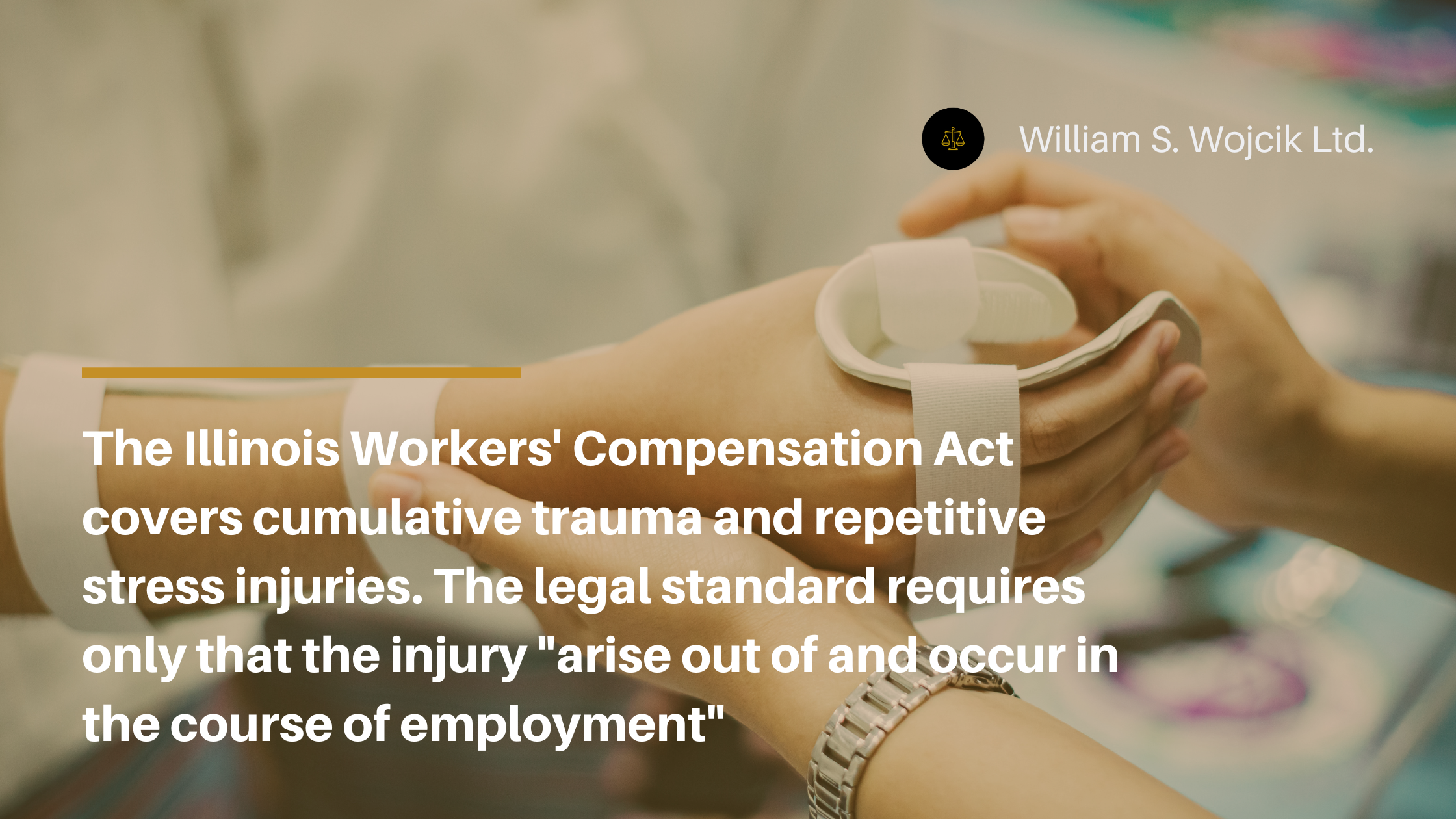
Yes, the Illinois Workers' Compensation Act covers cumulative trauma and repetitive stress injuries. 

The legal standard requires only that the injury "arise out of and occur in the course of employment", and Illinois courts have consistently held that gradual, work-related injuries meet that standard.

Common covered conditions include:

  • Tendinitis

  • Rotator cuff injuries

  • Carpal tunnel syndrome 

  • Occupational hearing loss

  • Herniated discs from repetitive lifting

These affect workers throughout Oak Lawn, Orland Park, and Cook County's southwest suburbs, warehouse and logistics workers, assembly line and manufacturing employees, construction tradespeople, healthcare workers, and cashiers alike.

Pre-existing conditions don't automatically disqualify a claim. 

If your job aggravated or accelerated a condition beyond its natural progression, Illinois law still recognizes coverage. The question isn't whether your body was healthy before you started; it's whether the work made it worse.

Proving Repetitive Stress and Occupational Injuries as Work-Related

Repetitive trauma cases are among the most disputed claims at the Illinois Workers' Compensation Commission (IWCC), and for a straightforward reason: causation is harder to establish without a single incident.

The key legal concept is the "manifestation date": the point when you knew, or reasonably should have known, that your condition was work-related. 

Illinois doesn't require you to name the exact day pain began. 

The clock typically starts at diagnosis, or when a treating physician first connects your condition to your job duties. That date controls both your 45-day notice window and your three-year filing deadline with the IWCC.

Why These Cases Are Challenged So Aggressively

Unlike a fall or machinery accident, repetitive stress injuries develop gradually. 

Insurance companies often argue:

  • The condition is due to aging or natural degeneration

  • There is no clear “injury event”, making the claim speculative

  • The injury came from activities outside of work (gym, hobbies, daily life)

This is why documentation, not just symptoms, becomes the foundation of your case.

The Role of Medical Evidence (Where Most Cases Turn)

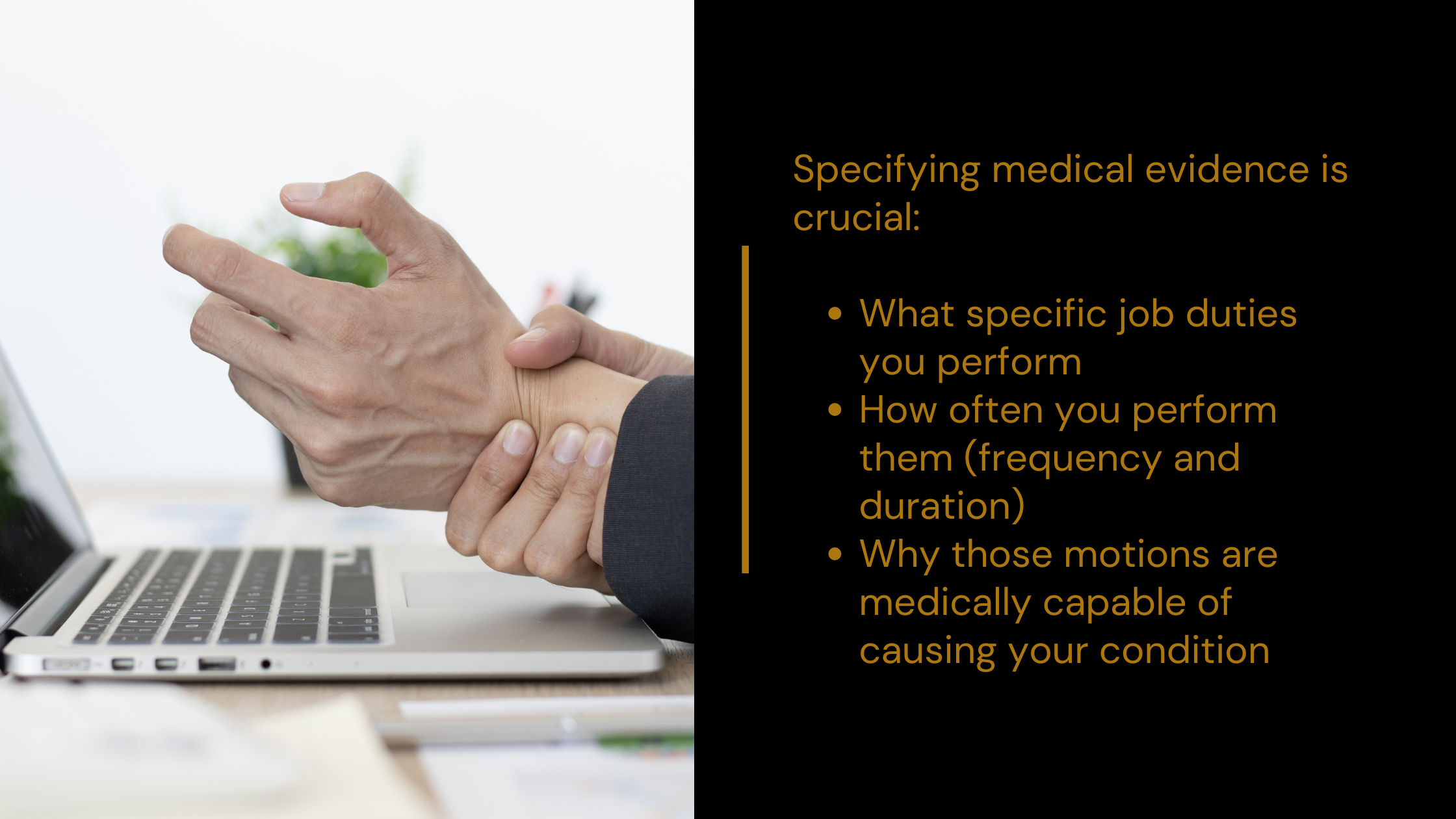
Your treating physician’s opinion is often the most important piece of evidence.A strong report doesn’t just diagnose — it provides crucial evidence that can help your case: 

  • What specific job duties you perform

  • How often you perform them (frequency and duration)

  • Why those motions are medically capable of causing your condition

For example, a note stating “patient has wrist pain” is weak.

A report stating “patient performs repetitive scanning and gripping motions for 8–10 hours per shift, which is consistent with the development of carpal tunnel syndrome” is far more persuasive before an IWCC arbitrator.

Job Duties Matter More Than Job Titles

One of the most common mistakes workers make is assuming their job title explains their injury. It doesn’t.

What matters is what you actually do every day.

Two employees with the same title in Oak Lawn or Orland Park may have completely different physical demands.

That’s why detailed descriptions of your work are critical:

  • How many lifts per hour

  • Weight of objects handled

  • Length of shifts and break frequency

  • Repetitive motions (twisting, scanning, typing, gripping)

The more specific the description, the stronger the claim.

Independent Medical Examinations (IME): What to Expect

The other major hurdle is the Independent Medical Examination.

Insurers routinely arrange an IME (an evaluation by a physician of their choosing) whose opinion often attributes the condition to aging or lifestyle rather than work.

An IME doesn’t end your case though.

It creates a conflict of medical opinions that an IWCC arbitrator must resolve, weighing (1) Familiarity with your job duties, (2) Consistency with your medical history, and (3) the depth of each physician’s evaluation.

In many cases, the treating physician, who has seen your condition develop over time, carries more weight when their opinion is detailed and well-supported.

Supporting Evidence That Strengthens a Claim

Successful repetitive stress claims are built on consistency across multiple forms of evidence.

What tends to strengthen these cases:

  • Ergonomic evaluations (when available)

  • Written job descriptions or employer documentation

  • A clear timeline of when symptoms began and worsened

  • Treating physician opinions linking job duties to the condition

  • Detailed medical records documenting symptom progression

  • Coworker or supervisor statements confirming work conditions

The strength of a repetitive trauma claim is almost always proportional to the completeness and consistency of documentation.

A Practical Reality Many Workers Overlook

Many injured workers delay reporting symptoms because they assume it’s “just soreness” or part of the job.

By the time they seek treatment, the condition is more advanced, and the paper trail is thinner.

From a legal standpoint, earlier documentation:

  • Strengthens credibility

  • Creates a clearer timeline

  • Reduces disputes about causation

Even if the injury developed gradually, your documentation doesn’t have to.

Deadlines You Cannot Miss When Filing for a Repetitive Stress or Occupational Injury Claim

The 45-day notice requirement runs from the manifestation date (when you knew the condition was work-related, not necessarily when the pain first appeared). 

Missing it doesn't automatically disqualify a claim, but it gives the insurer grounds to challenge it from the start and makes the process significantly harder.

The statute of limitations gives you three years from the date of injury — or two years from the last compensation payment, whichever is later, to file an Application for Adjustment of Claim with the IWCC. This deadline is absolute. A claim filed after it cannot be pursued.

When Do You Need a Workers Compensation Lawyer? 

Not every situation requires immediate legal action.

But it’s often worth having a conversation if:

  • Your claim has been denied or delayed

  • You’re unsure how to prove your job caused the injury

  • An IME attributes your condition to aging or non-work causes

  • Your symptoms have been building over time and you’re just now seeking treatment

But these cases don’t usually fail because the injury isn’t real. They fail because the connection between the work and the condition isn’t clearly established in a way the Illinois Workers’ Compensation Commission (IWCC) requires.

Where Most Claims Break Down

Repetitive stress claims involve multiple moving parts:

  • Medical opinions

  • Job duty documentation

  • Timelines tied to the manifestation date

  • Responses to insurer challenges and IMEs

A small gap in any one of these areas can weaken the entire case.

For example:

  • A doctor may diagnose the condition but not clearly connect it to your job

  • An employee may report symptoms but not describe their duties in enough detail

  • An IME report may go unchallenged, even when it’s incomplete or inconsistent

Individually, these seem minor. Legally, they can determine the outcome.

How Wojick Law Can Help With Your Case

At Wojcik Law, we change how your case is presented and supported.That typically includes:

  • Ensuring deadlines and filings with the IWCC are handled correctly

  • Challenging IME opinions when they overlook key facts or medical history

  • Identifying gaps or inconsistencies before the insurer uses them against you

  • Developing detailed job duty narratives that reflect the true physical demands of your work

We also have experience with cases across Oak Lawn, Bridgeview, Burbank, Evergreen Park, and the surrounding Cook County suburbs,  along with how repetitive trauma claims are typically challenged and how local employers and insurers approach these cases.

In repetitive trauma cases, clarity and consistency are everything. Legal guidance helps make sure both are in place.

Frequently Asked Questions

Can I be fired for filing a workers' comp claim?

No. Section 4(h) of the Illinois Workers' Compensation Act prohibits employer retaliation for filing or pursuing a claim. Termination, demotion, or other adverse action taken in response to a claim constitutes retaliatory discharge; a separate legal violation with its own remedies beyond the workers' comp benefits themselves.

What if I have a pre-existing condition?

A pre-existing condition doesn't disqualify your claim. If your job aggravated or accelerated the condition beyond what would have occurred naturally, Illinois law covers it. Medical documentation establishing how your work specifically worsened the condition is the key.

Schedule a Case Review With Wojcik Law

If you've been managing chronic pain or a diagnosis you suspect is connected to your work, understanding your rights is a reasonable place to start. You don't need an incident report. You don't need to know the exact date it began.

William S. Wojcik, Ltd. has represented injured workers throughout Chicago's southwest side and Cook County for more than 40 years  in Oak Lawn, Bridgeview, Burbank, Evergreen Park, Orland Park, Tinley Park, and across the south suburbs.

A free case review is available by calling (708) 423-8822. It's a conversation about your situation and what Illinois law may allow, not a commitment to anything further. If your condition is work-related, you deserve to know that.

Delayed Workers’ Comp Check in Chicago? A Legal Guide on How to Avoid Debt, Missed Rent, and Denied Care

What Counts As a “Delayed Workers’ Comp” in Illinois

In Illinois, workers’ comp benefits are not supposed to drag on forever in “processing.”

Under Illinois law:

  • Your employer’s insurance company usually has around 14 days after notice of your injury to start Temporary Total Disability (TTD) payments, as long as your claim is accepted and you’re off work by doctor’s orders.

  • Wage replacement benefits are typically two-thirds (66⅔%) of your average weekly wage, subject to state minimums and maximums.

If:

  • You reported your injury

  • You’re missing work

  • Your doctor says you can’t work

  • And weeks have passed with no check…

That’s a delayed workers’ comp claim.

And the longer you wait, the more pressure lands on you, not the insurance company.

For a Chicago worker, a delayed workers’ comp check almost always turns into money stress.

You still have:

  • Rent or mortgage in neighborhoods like Lakeview, Pilsen, or Jefferson Park.

  • Groceries, utilities, childcare.

  • Co-pays, prescriptions, gas or Uber to get to doctor appointments.

But your income has dropped to zero.

Most workers in this spot tell themselves:

  • “It’s probably just processing.”

  • “If I call, I might make them mad.”

  • “I don’t need a workers’ comp attorney yet.”

Meanwhile, time ticks by. Bills pile up. Your savings drain.

That’s exactly the kind of delay the Illinois workers’ comp system is supposed to prevent.

Step by Step Guide on Solving a Delayed Workers Comp in Chicago

Step 1: Make Sure You’ve Done These Basics

There are 3 crucial steps you have to complete when filing for a workers comp claim in Chicago.

1. Report your injury in time

In Illinois, you generally have 45 days to notify your employer of a work injury, but waiting that long can delay or hurt your claim.

Ideally, you should:

  • Report the injury as soon as possible.

  • Put it in writing (email or incident form).

  • Keep a copy or screenshot.

2. Saw a doctor and followed up

You need:

  • A medical record that links your condition to work.

  • A note showing work restrictions or that you cannot work.

No medical proof = easier for the insurer to stall or deny.

3. Confirmed who the insurance carrier is

You can usually find:

  • The carrier on workplace posters.

  • In HR documents.

  • Or by asking your employer.

You can also look at resources from the Illinois Workers’ Compensation Commission (IWCC) or its worker handbook to understand the process.

Step 2: Understand What the Insurance Company Might Be Doing

In our experience, insurance companies are one of the most common reasons for a workers comp delay.

Delays are often a tactic, not an accident.

Common reasons your delayed workers’ comp might drag on:

  • They claim they’re “still investigating.”

  • They’re waiting on more records but haven’t clearly told you what.

  • They hope you’ll go back to work before benefits kick in.

  • They want you to give up or accept a weaker position.

Illinois law allows for penalties and attorney fees when benefits are unreasonably delayed or withheld: 

“Any employer who fails to timely comply with a demand or final order issued by IDOL shall also be liable for:

a penalty, payable to IDOL, equal to 20% of the underpayment;

and a penalty, payable to the employee, equal to 1% per day of the underpayment, for each day that payment is delayed. Again, this penalty continues to accrue without limitation until the amount found owing is paid.”

But here’s the catch:

If you’ve brought this up with your employer and they refuse to comply, that’s where a workers’ comp attorney comes in.

Step 3: Short-Term Tips to Avoid Debt and Missed Rent

While you’re getting the legal side handled, there are a few practical steps you can take to protect yourself.

Make a quick “survival” budget

  • Must-pay items: rent, utilities, food, medicine.

  • Can-delay or reduce: subscriptions, extras, non-essential spending.

This isn’t forever. Think of it as a bridge until your workers’ comp benefits start or get back on track.

Keep every single document

  • Pay stubs and direct deposit history.

  • Medical records and off-work notes.

  • Texts and emails with your employer or adjuster.

  • Letters about delays, denials, or “investigations.”

These will serve as evidence and key details for your workers’ comp lawyer later.

Step 4: When to Call a Workers’ Comp Attorney

This is the point where most workers delay too long.

It’s a common notion…

  • “Lawyers are expensive.”

  • “I don’t want to be ‘that person’ who sues.”

  • “Maybe it’s normal; I don’t want to overreact.”

But would you be willing to wait for 6 months before receiving your workers comp? 

Before your situation gets more complicated, seeking legal assistance will not only minimize any future damage, but you’ll also get your claim in a faster time window.

  • A good workers’ comp lawyer in Chicago deals with insurance adjusters and delayed checks every day.

  • Workers’ comp attorneys also typically work on a contingency fee, often capped by statute, meaning they’re paid out of what they recover for you not up front.

  • At Wojcik, we file motions, request hearings, and in some cases seek penalties for unreasonable delays.

Clear signs it’s time to call a workers comp lawyer

You should contact a workers’ comp attorney in Chicago if:

  • Your benefits started, then suddenly stopped.

  • You’re getting vague answers like “We’re still reviewing your claim.”

  • You’re being pushed to return to work before your doctor clears you.

  • It’s been more than 2 weeks since you’ve been off work and you still haven’t received a check.

Talk to a Chicago workers’ comp lawyer about your delayed checks

Workers’ Comp Benefits vs. Short-Term Disability in Illinois: Key Differences

Workers’ Comp Benefits vs. Short-Term Disability in Illinois: Key Differences

“I got hurt at work. Do I file workers’ comp or use my company’s short-term disability?”

We get this concern a lot. 

However, 9/10 times, if your injury happened on the job in Illinois, workers’ comp is usually the correct path, not short-term disability.

Quick Comparison: Workers’ Comp vs. Short-Term Disability (Illinois)

In a nutshell, workers compensation is work-related while short term disability isn’t. 

Workers’ comp covers medical care at no out-of-pocket cost and pays wage benefits (typically two-thirds of your average weekly wage) after a brief waiting period, and it’s generally not taxable.

Short-term disability (STD) can help when the condition is not work-related.

If a comp claim is denied/under review, it usually won’t cover your work injury and benefits are often taxable if the employer pays the premiums. 

For an extensive overview between the two, the table below outlines key differences between workers comp and short-term disability.

Feature

Workers’ Compensation (IL)

Short-Term Disability (STD)

What it covers

Work-related injuries/illnesses (on-the-job or arising out of work)

Generally non-work-related injuries/illnesses

Medical bills

Employer/insurer must pay necessary medical care (subject to fee schedule; “two-doctor rule” applies)

Typically no medical coverage; it’s income replacement only

Wage replacement

Temporary Total Disability/Temporary Partial Disability wage loss (typically 2/3 of average weekly wage, with min/max caps)

% of income per policy (often 40–70%), caps vary

Waiting period

3 working days; if disability lasts 14+ days, retroactive to day 1

“Elimination period” often 7–14 days (policy-specific)

Taxes on benefits

Generally not taxable (state or federal)

Taxable if employer paid premiums or pre-tax; not taxable if employee paid with after-tax dollars

Choice of doctor

Limited but meaningful choice (e.g., two-doctor rule/PPP framework)

Any provider your plan accepts (policy governs)

Job protection

Workers compensation itself ≠ job protection; Family and Medical Leave Act or American Disabilities Act (FMLA/ADA) may apply

Short-term disability ≠ job protection; FMLA/ADA or employer policy applies

Primary when injury is on-the-job?

Yes—WC is the proper system for work injuries

Usually excluded for work injuries; may be used only if WC denied/pending

How Workers’ Comp Works in Illinois (Plain English)

  1. Eligibility: You were hurt because of your job (incident, repetitive strain, exposure).

  2. Medical care: The employer/insurer must pay for reasonable and necessary treatment under the Act—no copays/deductibles to you (subject to fee schedules).

  3. Wage checks: If you can’t work, you may get Temporary Total Disability (TTD), about two thirds or 66% of your AWW, subject to IB max/min. Waiting period: first 3 working days unpaid unless you’re out 14+ days, then it’s retroactive.

  4. Light duty: If on restrictions with lower pay, Temporary Partial Disability (TPD) can cover part of the wage gap.

  5. Tax treatment: Workers’ comp benefits are generally tax-free (federal and Illinois).

  6. Doctor choice: Illinois allows a limited choice of treating physicians (often described as a “two-doctor rule,” affected by any employer Preferred Provider Program)

Workers Comp Example

You wrench your back lifting a pallet in Joliet.

This means a trip to the ER, along with MRI scans and possibly a few weeks session for physical therapy. 

Under Illinois Workers Comp, your medical bills are covered, and you receive TTD checks while off. 

If you’re out more than two weeks, the first three days get paid retroactively. 

How Short-Term Disability Works (and when it fits)

  • What it is: An insurance policy, typically through your employer, that replaces part of your income when you can’t work due to non-work injuries/illnesses (e.g., off-duty fall, surgery, pregnancy recovery). It usually excludes work injuries because workers’ compensation is primary.

  • Waiting period: Policies often have a 7–14 day elimination period before benefits start

  • Benefit amount: Often 40–70% of pre-disability wages for a few weeks to months (policy-dependent).

  • Taxes: If your employer funds premiums or they’re pre-tax, benefits are taxable; if you pay with after-tax dollars, they’re usually not taxable.

Can You File for a Workers Comp and Short-Term Disability At The Same Time?

You cannot file for both Workers’ Comp and Short-term Disability at the same time since both have different natures of circumstances. 

One happens at work, while the other happens outside of work. 

For work related cases, it’s always preferable to file for a workers comp immediately

Think about medical costs, consultations, and other fees. These are only covered for workers comp but not short-term disability.

If your work injury claim is denied or under investigation, some employees temporarily apply for short-term disability to keep income flowing

Most STD policies offset or stop once workers’ comp pays. 

Coordinate carefully so you don’t have to repay benefits later. 

Workers Comp Rates in Illinois

2025 Workers Comp Rates in Illinois

Based on the data from Illinois’ Workers Comp law, these are the maximum rates depending on the case and benefit types.

Benefit Type Rate / Cap
Statewide Average Weekly Wage (SAWW) $1,452.68
Maximum TTD / PTD / Death / Amputation / Eye $1,936.86 per week
Maximum PPD (non-amputation / non-eye) $1,045.92 per week
Minimum TTD (base, no dependents) $400.00 per week
Mandatory Maximum Total Compensation Cap $500,000 OR 25 years, whichever is greater

Why People Mix Workers’ Comp and Short Term Disability (and how to prevent an undermine claim)

  • STD feels faster and HR may know it well, so some workers default to this process even after an on-the-job injury.

  • The risk of choosing STD for a work injury can undermine your comp claim (In several cases, we’ve seen the insurer argue it’s non-work).

  • If it happened at work, report it as work-related, file the WC claim, follow medical advice, and consult counsel. You can layer STD only if your WC claim is formally denied/pending, and even then, keep in mind about any offsets/taxes.

Which is the Better Option?

If the injury/illness is…

  • Work-related (forklift incident, repetitive strain, exposure): Workers’ Comp → medical bills + wage benefits (usually tax-free).

  • Not work-related (off-duty fall, non-occupational surgery recovery): Short-Term Disability (policy rules, taxes depend on who paid premiums).

  • Work-related but your employer disputes it: Start WC anyway, consider STD as a bridge while you appeal and coordinate to avoid overpayments.

Confused about which path to file? Get clarity in minutes. Contact Wojcik Law for a free case review. We’ll triage your options and protect your paycheck.

First 72 Hours After a Work Injury (Checklist)

  1. Report the injury to your employer in writing; note date/time/location/witnesses.

  2. Get medical care and tell the provider it’s work-related (so billing routes to WC).

  3. Follow restrictions; keep copies of work notes.

  4. Track wages (for AWW accuracy).

  5. Call a workers’ comp lawyer if there’s any dispute, delay, or pressure to use STD instead of WC.

In our experience, the biggest mistake is using private health insurance or STD for a work injury—it undermines the claim and risks out-of-pocket costs you didn’t need to pay.

Workers Comp vs Short Term Disability FAQs

Does workers’ comp pay more than short-term disability in Illinois?

Workers comp pays more since it covers both medical bills/expenses and wage benefits (often tax-free). Although short-term disability compensates between 60 to 70% of your total wage, it’s also taxable leading to a lower net pay, and you shoulder the medical costs as well. 

How much does workers’ comp pay per week in Illinois?

A workers comp pay per week generally sits at about 2/3 of your average weekly wage, and it’s subject to min/max (between $400 to around $1,900) set by the state. So if you’re average weekly pay is 1,000 you get a net take home pay of $666.67. 

What is the Illinois workers’ comp waiting period?

Under Illinois law, the average workers comp waiting period is three working days but can be longer than that; if you’re off 14+ days, you’re paid retroactively from day one.

Are workers’ comp benefits taxable in Illinois?

Workers comp benefits are generally not taxable at state or federal levels.

Does short-term disability cover work injuries?

STD policies usually exclude work injuries because workers’ comp is the primary remedy.

Will I lose my job while on WC or STD?

Neither WC nor STD guarantees job protection. FMLA (if eligible) can protect up to 12 weeks; ADA may also require reasonable accommodation.

Looking for a Workers Comp Attorney in Oak Lawn, Illinois?

If you need help filing for a workers’ compensation claim, or need to consult a workers’ comp attorney due to an irregular or abnormal case, you can reach us at 708-424-2121.

Our full address is 4550 W 103rd St # 101, Oak Lawn, IL 60453. 

How to File a Workers’ Compensation Claim in Oak Lawn, IL — Step-by-Step Legal Guide

You got hurt at work in Oak Lawn. Maybe it was a fall on a slippery warehouse floor. Maybe it was back strain after years of heavy lifting. 

Now, you’re left with two pressing fears:

Will I get the medical care and wage benefits I need?

What if I make a mistake and lose everything?

In my experience, most injured workers hesitate not because they don’t want to file — but because the Illinois workers’ comp system feels like a maze. Deadlines, forms, employer pushback… it’s overwhelming.

That’s exactly why this guide exists. Step by step, I’ll show you how to file a workers’ compensation claim in Oak Lawn — and where our firm - William S. Wojcik, Ltd. - comes in to protect your rights.

Understanding Workers’ Compensation in Illinois

Workers’ compensation is designed to protect you when an on-the-job injury disrupts your life. 

A good example would be to consider a delivery driver in Chicago who slips on a wet warehouse floor while carrying a package.

Why and how does workers’ compensation apply?

  • The fall happens during a required work task (moving deliveries).

  • The injury results in a sprained ankle that requires medical treatment and time off.

  • Workers’ compensation can cover ER visits, follow-up care, and partial wage replacement while the employee recovers.

Under the Illinois Workers’ Compensation Act, most employees are covered — from factory workers in Oak Lawn’s industrial corridor to office staff in the 103rd Street business district

Who is Covered?

  • Union and non-union workers

  • Full-time and part-time employees

  • Most industries: manufacturing, healthcare, construction, retail, office work

In most cases, coverage applies regardless of fault. 

That said, a workers compensation lawyer can provide more details and information regarding coverage application and how the nature of the injury affects your overall coverage. 

Types of Benefits You Can Claim

Not all work-related injuries come with the same benefits meaning, the benefits (as listed below) aren’t fixed claims for every injury. 

Instead, these benefits are a general overview of what you may expect when filing for a workers compensation claim. 

  • Survivor benefits: If a worker dies due to a workplace injury

  • Permanent disability benefits: If you cannot fully return to work

  • Medical care: All reasonable treatment costs, with no out-of-pocket expense

  • Wage replacement: Usually 2/3 of your average weekly wage while you recover

  • Vocational rehab: Training for a new role if you can’t perform your old job

  • Survivor benefits: If a worker dies due to a workplace injury

Confused? 

A  good way to think about workers’ comp is that it acts as your financial lifeline when your paycheck is suddenly cut off by injury.

Learning more about the step-by-step process should shed more light on the matter. 

Step-by-Step: Filing a Workers’ Compensation Claim in Oak Lawn

Filing for a workers compensation claim is  where most people struggle. 

The process looks straightforward, but each step has rules and deadlines that can derail your claim if you’re not careful or worse, undercompensation. 

Step 1: Report the Injury Immediately

Under Illinois law, you must notify your employer within 45 days of the injury. Sooner is better.

When reporting, include:

  • How the injury occurred

  • Names of any witnesses

  • Date, time, and location of injury

Nature of the injury (back strain, fall, repetitive stress, etc.)

Warning: Failing to report in time may bar you from benefits. Don’t assume “my boss knows what happened” counts as formal notice.

Step 2: Seek Prompt Medical Treatment

Your health comes first. Go to a doctor right away and tell them the injury is work-related.

In Illinois, you’re entitled to:

  • Choose up to two doctors (plus any specialists they refer you to)

  • All necessary treatment at no cost

  • Ongoing treatment while your claim is pending

Keep a paper trail: diagnostic tests, prescriptions, therapy notes, and discharge instructions. In my experience, weak or missing medical documentation is the #1 reason insurers try to deny claims.

Step 3: Consult a Workers’ Compensation Attorney

Here’s where many workers go wrong — they try to “DIY” the process until something goes sideways. 

By then, deadlines are missed, or paperwork is mishandled.

The result? Longer wait times, undercompensation, and you’re left to carry the burden of all the expenses yourself. 

At William S. Wojcik, Ltd., we provide:

  • Immediate case evaluation

  • Representation at hearings or arbitration if needed

  • A tailored legal strategy based on your injury and job type

  • Handling of all employer and insurance communications

Step 4: File a Claim with the Illinois Workers’ Compensation Commission (IWCC)

If your employer refuses benefits, or if payments are delayed, the next step is a formal claim with the IWCC.

This includes:

  • Proof of employment

  • Wage documentation

  • Medical records and bills

  • Application for Adjustment of Claim (Form IC-1)

Once filed, your case may proceed to arbitration or hearing. Wojcik Law represents you through each stage, making sure deadlines are met and your story is clearly presented.

Step 5: Track Your Recovery and Benefits

After filing, your claim doesn’t run on autopilot. 

Stay engaged:

  • Follow up your treatment plan

  • Attend all medical appointments

  • Report progress (or setbacks) to your attorney

  • Keep records of any missed workdays and lost wages

Details matter. And being thorough goes a long way to get a full claim. 

While it’s certainly possible to do this yourself, having a professional legal team and workers compensation lawyer helps you maintain compliance so benefits continue without interruption.

Think of us as both your advocate and your navigator through a system designed to confuse.

Common Pitfalls to Avoid When Filing a Workers’ Compensation Claim in Illinois

Missing the 45-day deadline to report your injury

  • Why it matters: Most states (including Illinois) require workers to notify their employer within a specific timeframe (often 30 to 45 days maximum). Waiting too long can make your injury look suspicious or unrelated to work.

  • Pitfall: Thinking the injury will “get better on its own” and waiting weeks before saying anything.

  • Fix: Report the injury immediately — even if it seems minor at first.

Underreporting symptoms or skipping medical follow-ups

  • Why it matters: Medical records are the backbone of a claim. If there’s no doctor visit right after the injury, insurance adjusters can easily argue it didn’t really happen at work.

  • Pitfall: Relying only on self-care or skipping the doctor because of fear of cost or losing hours at work.

  • Fix: Get checked by a doctor as soon as possible and follow all treatment recommendations.This will also strengthen your claim.

Trusting the insurance adjuster without legal review

  • Why it matters: Workers’ comp laws are complex, and insurers aim to minimize payouts. Without guidance, injured workers often accept less than they deserve.

  • Pitfall: Settling quickly without knowing the long-term impact of your injury.

  • Fix: It’s strongly encouraged to speak with a workers’ compensation lawyer even for consultation to understand your rights.

 DIY filing — thinking you’ll save money, only to lose benefits

  • Why it matters: Workers’ comp requires consistent details — when, where, how, and what happened. Any inconsistency can be used to question credibility.

  • Pitfall: Saying “my back hurts” without explaining that the pain started after lifting equipment at work.

  • Fix: Keep a personal record of the incident, symptoms, and all medical visits. Always give the same account of what happened. Be as detailed, thorough, and accurate as possible.

Assuming Your Employer Handles Everything

  • Why it matters: While employers must notify their insurance, they may delay, mishandle, or even discourage claims. You are responsible for protecting your rights.

  • Pitfall: Trusting verbal reassurances like “We’ll take care of it.”

  • Fix: File the required paperwork yourself and keep copies. Or, work alongside a workers compensation lawyer to ensure the paperwork doesn’t fire back at you.

Appeals & Hearing Process If Your Claim Is Denied

If your claim was denied, don’t panic. 

Denials happen — often due to incomplete forms, “pre-existing condition” arguments, or disputes over medical necessity. 

Here’s what the appeal process looks like in Illinois:

  • File an appeal with the IWCC

  • Gather additional medical and workplace evidence

  • Attend arbitration hearings (with your attorney advocating for you)

Without experienced representation, appeals drag on. 

With Wojcik Law, appeals are strategic — aimed at winning benefits quickly and fairly.

Why Hire a Chicago Attorney vs. DIY

Can you file on your own? Yes. 

Should you? That’s another question.

The reality:

Employers have attorneys working against you

Insurance companies minimize payouts to protect profits

Workers without representation often accept lower settlements

Does that mean hiring a lawyer is the only way? 

If you want a higher success rate, yes it’s encouraged. However, there are a lot of ways to go about it too. 

For one, you can draft the documentation yourself and file the paperwork, then consult a workman’s comp lawyer to fact-check or proofread the information. 

Would you spend extra hours on top of work and while fighting your injury to get what you deserve or ask for help to save you time, resources, and effort? 

This is where we come in. 

Hiring us here at  William S. Wojcik, Ltd. means having a Chicago workman’s comp attorney who knows the system inside out. We also have the success stories to prove it. 

Clients consistently say the same thing: “I wish I’d called sooner.”

Frequently Asked Questions About Filing a Workers’ Compensation Claim in Illinois Chicago

What is the deadline to file a workers’ compensation claim in Illinois?

You must notify your employer within 45 days and file a claim within 3 years of the injury or 2 years of the last compensation payment.

Can I choose my own doctor?

Yes. Illinois law allows you to select your own physician for treatment.

What benefits am I eligible for?

The benefits you are eligible for a workman’s compensation claim include medical care, wage replacement (typically 2/3 of your average weekly wage), permanent disability, and vocational rehabilitation.

What if my claim is denied?

If your claim was denied, you can appeal through the Illinois Workers’ Compensation Commission. Having an attorney dramatically improves success rates.

How long does it take to get benefits?

It varies. Some cases resolve in weeks; complex cases may take months, especially if appeals are involved.

Get Legal Help for Your Workers’ Comp Claim Today

Filing a workers’ comp claim in Oak Lawn isn’t just about forms. It’s about securing your health, income, and dignity after an injury.

With William S. Wojcik, Ltd., you don’t just get legal guidance — you get a local advocate who’s stood by injured workers across Chicago and Cook County for decades.
Ready to get the benefits you deserve? Call (708) 423-8822 or submit your claim review form online.

What Damages Can I Recover from a Commercial Truck Accident Settlement?

If you’ve been hit by a semi-truck or other commercial vehicle in Illinois, you’re probably asking: What damages can I recover from a truck accident settlement?

 A single crash can:

  • Generate six-figure medical expenses.

  • Put you out of work for months or permanently.

  • Trigger emotional scars (anxiety, PTSD) that don’t heal as quickly as bones.

At William Wojcik Law, we’ve spent over three decades helping accident victims across the Chicagoland area recover the full compensation they’re entitled to under Illinois law. 

Before accepting any offers from an insurance adjuster, here’s what you need to understand first. 

Understanding Truck Accident Settlements in Illinois

Truck accidents are not like regular car crashes. These claims are governed by a unique set of laws and usually involve:

  • Complex insurance policies with high-dollar limits

  • Federal regulations from the Federal Motor Carrier Safety Administration (FMCSA)

  • Multiple liable parties, such as the truck driver, trucking company, cargo loaders, or maintenance contractors

Because of the serious injuries typically involved, commercial truck settlements can reach up to hundreds of thousands — or even millions — of dollars. But getting full value means understanding what you're owed.

And if you’ve already gotten the first lowball call from an insurance adjuster? We’ve seen this happen too often. Most victims don’t realize how much compensation they’re entitled to until an attorney breaks it down.

This is why we stress the importance of truck accident settlement damages in Illinois.

Types of Recoverable Damages

A truck crash claim usually includes three categories of damages: economic, non-economic, and punitive (in rare cases).

1. Economic Damages (Special Damages)

Economic damages are your receipts and bills. They’re easy to document, but often underestimated by insurers. Some examples include:

  • Medical Bills: ER visits, surgeries, prescriptions, physical therapy, rehab equipment.

    • Example: A delivery driver racked up $180,000 in medical bills after a crash. His settlement included every penny, plus future care needs.

  • Lost Wages + Future Earnings: Compensation for time off now and for reduced earning potential.

    • Example: A warehouse worker unable to return to heavy lifting secured damages for projected 15 years of reduced income.

  • Property Damage: Car repairs or replacement value.

  • Out-of-Pocket Costs: Mileage to appointments, childcare, home modifications (wheelchair ramps).

Illinois Statute Requirement: Courts require damages be proven with “reasonable certainty.” That’s why documentation (receipts, employment records, medical reports) is critical.

2. Non-Economic Damages (General Damages)

Non-economic damages are harder to measure, but usually make up the largest category.

  • Pain & Suffering: Daily discomfort, surgeries, or lifelong pain.

  • Emotional Distress: PTSD, nightmares, anxiety while driving.

  • Loss of Enjoyment of Life: Missing milestones or hobbies (e.g., not being able to coach your child’s soccer team).

  • Loss of Consortium: When a spouse or partner loses companionship, intimacy, or support.

One client’s inability to attend his daughter’s prom after a crash wasn’t just “inconvenience” — it was part of his non-economic damages claim.

3. Punitive Damages

Punitive damages are rare, but powerful. These damages are designed to punish reckless or intentional misconduct.

Illinois law allows punitive damages in cases like:

In Cook County, punitive damages were awarded when a company allowed a driver with multiple DUIs to stay on the road.

Comparison Table: Economic vs. Non-Economic vs. Punitive 

Type of DamageWhat It CoversExample
Economic (Special)Tangible costs (medical, lost wages, repairs)$200k in medical bills, 6 months of lost pay
Non-Economic (General)Intangible harm (pain, suffering, emotional loss)PTSD, inability to enjoy sports/family events
PunitivePunishment for reckless conductDrunk driver → additional financial penalty

What Affects the Value of Your Truck Accident Settlement?

Truck accident settlements aren’t one-size-fits-all. Factors include:

  • Severity of Injuries: Catastrophic injuries (paralysis, brain injury) = higher awards.

  • Level of Negligence: Was the driver careless, or was the company violating federal regs?

  • Insurance Policy Limits: Commercial trucks often carry $750k–$5M+ liability policies.

  • Evidence Quality: Black box data, witness testimony, medical records, accident reconstructions.

  • Comparative Negligence in Illinois:

    • Illinois follows modified comparative negligence (735 ILCS 5/2-1116).

    • If you’re 20% at fault, your damages drop 20%.

    • If you’re 51%+ at fault, you recover nothing.

Truck vs. Car Accident Settlements

The complexity of truck accidents vary significantly from car accidents. Everything from insurance and liabilities to federal laws and injury severity: 

FactorCar AccidentTruck Accident
Insurance Coverage$25k minimum in Illinois$750k–$5M+ commercial liability policies
Liable Parties1–2 (drivers)Driver, company, cargo loaders, etc.
InjuriesModerate → severeSevere → catastrophic
RegulationsState traffic lawsFederal FMCSA + state laws
Typical Settlements$10k–$100k$100k–millions

How an Attorney Helps Maximize Your Settlement

Hiring a truck accident lawyer is not just about filing paperwork — it’s about building leverage. At William Wojcik Law, we:

  • Identify all liable parties, not just the driver

  • Negotiate directly with trucking insurers and legal teams

  • Investigate the crash using accident reconstruction experts

  • Collect vital evidence like black box data, driver logs, and maintenance records

If needed, we also take your case to trial.

Why Clients Trust William Wojcik Law After a Truck Crash

  • No fees unless we win

  • Personalized attention – You work directly with your attorney

  • 30+ years of experience handling personal injury and truck crash cases

  • Millions recovered for victims across Cook County and the south suburbs

We understand the devastating impact these accidents can have, and we’re here to fight for the maximum compensation the law allows.

FAQs About Truck Accident Compensation

What’s the average settlement in Illinois?

There’s no true “average” settlement in Illinois. Truck cases often settle for significantly more than car accidents — sometimes in the millions — depending on severity.

How long does a settlement take?

A settlement can take anywhere from months to years. Severe cases with multiple defendants can take longer.

What if I was partially at fault?

Under Illinois comparative negligence, you can recover if under 51% at fault.

Do cases always go to trial?

Not all cases go to trial. Many settle out of court, but trial remains a powerful tool when insurers lowball.

What is the statute of limitations?

The statute of limitations for accidents is 2 years from the accident date (735 ILCS 5/13-202).

Claim Your Truck Accident Settlement Today

If you’ve been injured in a truck crash in Illinois, urgency is critical. Evidence disappears. Witnesses forget. And insurance companies will try to settle cheaply.

Call William Wojcik Law today at (708) 424-2121 or fill out our quick online contact form for a consultation.

Semi-Truck Rollover Accident Law Firm: Legal Justice for Victims

Semi-Truck Rollover Accident Law Firm: Legal Justice for Victims

Were You Affected by the I-55 Truck Crash in Montgomery, Illinois?

Don't wait. Call Wojcik Law today at 708-487-6549 for a free legal consultation.  We’ll review your case within 24 hours and help you understand your options — no pressure, no fees unless we win.

Semi-Truck Collision in Montgomery, IL: Navigating the Aftermath

State of Illinois Motor Vehicle CollisioNs

(Why You Need an Experienced Trucking Accident Lawyer in Your Corner)

Alright, let's cut through the noise. That recent gut-wrenching news out of Montgomery, Illinois – the one ABC 7 Chicago covered, about the fatal smash-up at Route 31 and Caterpillar Drive?

A fatal crash occurred on May 1, 2025, at the intersection of Route 31 and Caterpillar Drive in Montgomery, Illinois, involving a semi-truck and a black Nissan sedan., trsveling southbound on Route 31 when the semi-truck, traveling northbound, attempted to make a left turn onto Caterpillar Drive. The sedan collided with the truck, becoming pinned underneath it,

The semi-truck driver tried to stop but could not avoid the collision.

The Kane County Accident Reconstruction Team, Illinois State Police, and Montgomery police are investigating the crash, including factors such as driver distraction, fatigue, and potential mechanical issues with the truck

It’s a brutal kick in the teeth, a stark reminder that life can flip upside down in a blink. Our hearts here at Wojcik Law in Oak Lawn go out to his family and friends.

This isn't just a news story; it's a tragedy that plays out way too often on our Illinois roads.

While the Illinois State Police, the Kane County Accident Reconstruction Team (KCART), and Montgomery police are still sifting through the wreckage of that sedan-versus-semi horror show, let's be brutally honest: these things are messy. And when the dust settles, or even before, if you're caught in the aftermath – whether you're nursing injuries or grieving a loved one – you’re probably drowning in questions.

You need answers, and fast. More importantly, you need to know your Illinois car accident rights.


Listen, when metal twists and lives are shattered, "understanding your rights" isn't some fluffy legal term. It's your lifeline.


The Blame Game: What "Negligence" REALLY Means in a Wreck

Forget the fancy legal jargon for a second. Most Illinois traffic accidents boil down to one thing: someone screwed up. That "screw up" is what we call negligence.

Think of it like this: someone wasn't being as careful as any reasonable Joe or Jane would be, and because of that carelessness, BAM! Someone gets hurt, or worse.

What kind of screw-ups are we talking about?


Driver Errors: This is a big one. Speeding like a bat outta hell, texting your buddy instead of watching the road (distracted driving Illinois is a killer), driving blitzed on booze or drugs, blowing through red lights, ignoring stop signs, failing to yield… the list of bonehead moves is long.


Truck Driver Negligence (When a Big Rig is Involved): Now, when you're dealing with a semi-truck accident, you're in a different league. These guys are pros, or they're supposed to be. We're talking about truck driver fatigue (those hours-of-service rules exist for a reason!), shoddy training, overloaded trucks, garbage vehicle maintenance, and flat-out ignoring federal trucking regulations.

If you've been hit by a truck, you need a truck accident attorney in Illinois who knows these specific rules inside and out.


Roadway Disasters: Sometimes, it's not just the drivers. Crappy road maintenance, signs that are confusing or missing, or intersections designed by a committee of confusion can stack the odds against you.

Your Playbook: Know Your Rights After an Illinois Traffic Accident

If you or someone you love has been smashed up or, God forbid, killed in an Illinois traffic accident, you've got fundamental rights. Don't let anyone tell you otherwise.


The Right to Get Paid (Compensation, Baby!): If some other knucklehead’s negligence caused the wreck, you have the right to go after them for what you've lost. We're talking Illinois car accident compensation for:Medical bills (the ones you have now and the ones coming down the pike).

  • Lost wages (can't work, can't earn – that's real money).

  • Future lost earning capacity (if your injuries mean you can't do the same job).

  • Pain and suffering (because "ouch" doesn't begin to cover it).

  • Property damage (your ride is probably toast).

And in the absolute worst-case scenario, a wrongful death claim in Illinois can cover funeral expenses, loss of companionship, and the financial support the deceased provided.

The Right to a Real Investigation: You deserve to know exactly what happened. Law enforcement will do their thing – gathering evidence, talking to witnesses, trying to piece it all together. But sometimes, you need more.


The Right to Bring in the Big Guns (Legal Representation): Trying to wade through the legal swamp and fight with insurance companies after a serious accident? That’s like trying to perform surgery on yourself. You have the RIGHT to hire an experienced Illinois personal injury lawyer. Someone who eats, sleeps, and breathes this stuff. Someone who will fight for YOUR interests, conduct their own deeper investigation, tell the insurance vultures where to stick it, and drag them into court if they don't play fair.

Why Wojcik Law? Because "Good Enough" Doesn't Cut It When Your Life is Wrecked.


At Wojcik Law, right here in Oak Lawn and serving the whole Chicago area, we get it. We've seen the devastation these accidents cause. We're not just paper-pushers; we're advocates, and damn good ones. We're committed to giving you straight talk and relentless representation when someone else's stupidity turns your world upside down. If you're searching for a dedicated car accident lawyer near me in the Chicago area, we're ready.


Here’s how our experienced Illinois personal injury attorneys go to bat for you:


We Dig Deeper: We launch our own independent investigation. We want to know exactly what happened and who’s responsible. Sometimes there’s more than one at-fault party.

Evidence is Everything: We gather and lock down every shred of proof to build a rock-solid case. Memories fade, evidence disappears – we move fast.

We Cut Through the Red Tape: Dealing with insurance companies and legal paperwork is a nightmare. We shoulder that burden so you can focus on healing. Understanding what to do after a car accident in Illinois is our job.

We Don't Back Down from Insurance Bullies: Insurance companies are in business to make money, not to be your friend. We negotiate aggressively to get you every dime you deserve.

Your Guide Through the Storm: We're with you every step of the way, explaining things in plain English, not confusing legalese.

Courtroom Warriors (If Necessary): If the other side won't be reasonable, we're not afraid to take the fight to a judge and jury to protect your rights and get you maximum compensation.

Moving Forward When Everything Feels Broken


That Montgomery tragedy is a punch to the gut. It reminds us that the road can be a dangerous place. As the investigation continues, the most important thing for anyone impacted by any traffic accident is to get smart about their rights and get experienced legal help on their side, pronto.

If you or a loved one has been caught in the crosshairs of an Illinois traffic accident, don't wait. Don't guess. Call Wojcik Law. Your consultation is free. We'll listen, we'll get what you're going through, and we'll lay out a clear path forward.

Now, the investigation into the Route 31 and Caterpillar Drive collision is still open, so we're not pointing fingers. But generally, when we're talking about negligence in traffic accidents, it often boils down to:

LE investigating serious crash involving semi in Montgomery

Driver Goofs: This is a big one. We’re talking speeding like a bat outta hell, texting while driving (seriously, people?), driving drunk or high, blowing through red lights, or just not paying attention. Any of these can turn a car into a weapon. If you suspect distracted driving in Illinois caused your accident, that's a major point.

Trucker Negligence – A Whole Different Scene when a big rig is involved, like in the Montgomery tragedy, the rulebook gets thicker. Was the driver exhausted from too many hours on the road (a huge issue in commercial truck accidents in Illinois)? Were they properly trained? Was the truck overloaded or poorly maintained?