Some of the most serious work injuries don't happen in an instant; they build over months or years of the same motion:
Lifting, gripping tools, typing, scanning, turning the same bolt on the same assembly line, shift after shift.
By the time the pain is impossible to ignore, many Illinois workers across Cook County have convinced themselves they don't have a case. There was no accident. No single day they can point to. No incident report filed.
That assumption is frequently wrong, and it costs people real medical care and real money.
The Illinois Workers' Compensation Act covers repetitive stress injuries, cumulative trauma injuries, and occupational diseases. You do not need a single identifiable accident to qualify for benefits. If your job duties caused or significantly contributed to your condition, you may have a valid claim, regardless of how gradually the damage developed.
William S. Wojcik, Ltd. has represented injured workers across Chicago's southwest side and Cook County for more than 40 years.
Does Illinois Workers' Comp Cover These Injuries?
Yes, the Illinois Workers' Compensation Act covers cumulative trauma and repetitive stress injuries.
The legal standard requires only that the injury "arise out of and occur in the course of employment", and Illinois courts have consistently held that gradual, work-related injuries meet that standard.

Common covered conditions include:
Tendinitis
Rotator cuff injuries
Carpal tunnel syndrome
Occupational hearing loss
Herniated discs from repetitive lifting
These affect workers throughout Oak Lawn, Orland Park, and Cook County's southwest suburbs, warehouse and logistics workers, assembly line and manufacturing employees, construction tradespeople, healthcare workers, and cashiers alike.
Pre-existing conditions don't automatically disqualify a claim.
If your job aggravated or accelerated a condition beyond its natural progression, Illinois law still recognizes coverage. The question isn't whether your body was healthy before you started; it's whether the work made it worse.
Proving Repetitive Stress and Occupational Injuries as Work-Related
Repetitive trauma cases are among the most disputed claims at the Illinois Workers' Compensation Commission (IWCC), and for a straightforward reason: causation is harder to establish without a single incident.
The key legal concept is the "manifestation date": the point when you knew, or reasonably should have known, that your condition was work-related.
Illinois doesn't require you to name the exact day pain began.
The clock typically starts at diagnosis, or when a treating physician first connects your condition to your job duties. That date controls both your 45-day notice window and your three-year filing deadline with the IWCC.
Why These Cases Are Challenged So Aggressively
Unlike a fall or machinery accident, repetitive stress injuries develop gradually.
Insurance companies often argue:
The condition is due to aging or natural degeneration
There is no clear “injury event”, making the claim speculative
The injury came from activities outside of work (gym, hobbies, daily life)
This is why documentation, not just symptoms, becomes the foundation of your case.
The Role of Medical Evidence (Where Most Cases Turn)
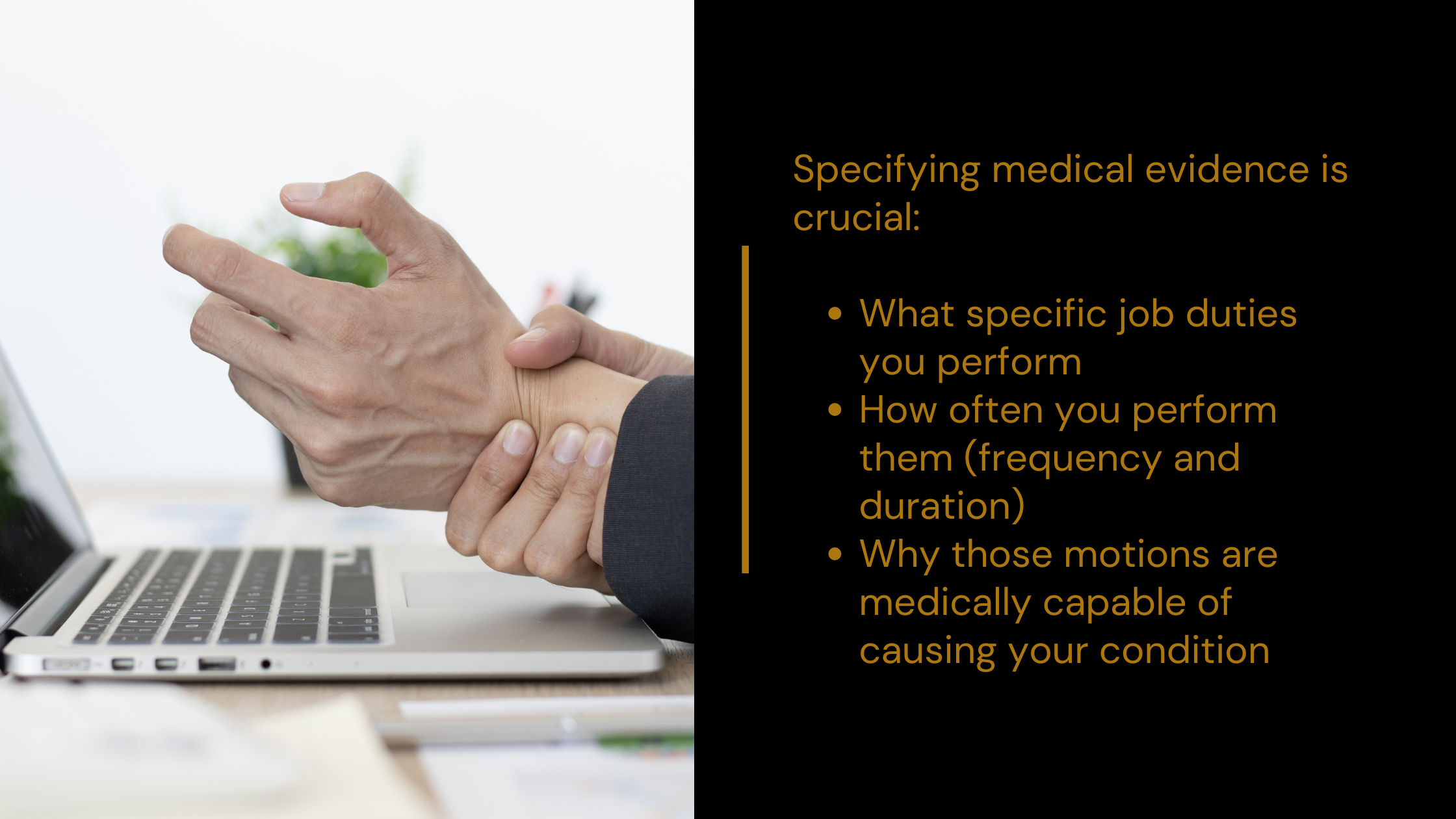
Your treating physician’s opinion is often the most important piece of evidence.A strong report doesn’t just diagnose — it provides crucial evidence that can help your case:
What specific job duties you perform
How often you perform them (frequency and duration)
Why those motions are medically capable of causing your condition
For example, a note stating “patient has wrist pain” is weak.
A report stating “patient performs repetitive scanning and gripping motions for 8–10 hours per shift, which is consistent with the development of carpal tunnel syndrome” is far more persuasive before an IWCC arbitrator.
Job Duties Matter More Than Job Titles
One of the most common mistakes workers make is assuming their job title explains their injury. It doesn’t.
What matters is what you actually do every day.
Two employees with the same title in Oak Lawn or Orland Park may have completely different physical demands.
That’s why detailed descriptions of your work are critical:
How many lifts per hour
Weight of objects handled
Length of shifts and break frequency
Repetitive motions (twisting, scanning, typing, gripping)
The more specific the description, the stronger the claim.
Independent Medical Examinations (IME): What to Expect
The other major hurdle is the Independent Medical Examination.
Insurers routinely arrange an IME (an evaluation by a physician of their choosing) whose opinion often attributes the condition to aging or lifestyle rather than work.
An IME doesn’t end your case though.
It creates a conflict of medical opinions that an IWCC arbitrator must resolve, weighing (1) Familiarity with your job duties, (2) Consistency with your medical history, and (3) the depth of each physician’s evaluation.
In many cases, the treating physician, who has seen your condition develop over time, carries more weight when their opinion is detailed and well-supported.
Supporting Evidence That Strengthens a Claim
Successful repetitive stress claims are built on consistency across multiple forms of evidence.
What tends to strengthen these cases:
Ergonomic evaluations (when available)
Written job descriptions or employer documentation
A clear timeline of when symptoms began and worsened
Treating physician opinions linking job duties to the condition
Detailed medical records documenting symptom progression
Coworker or supervisor statements confirming work conditions
The strength of a repetitive trauma claim is almost always proportional to the completeness and consistency of documentation.
A Practical Reality Many Workers Overlook
Many injured workers delay reporting symptoms because they assume it’s “just soreness” or part of the job.
By the time they seek treatment, the condition is more advanced, and the paper trail is thinner.
From a legal standpoint, earlier documentation:
Strengthens credibility
Creates a clearer timeline
Reduces disputes about causation
Even if the injury developed gradually, your documentation doesn’t have to.
Deadlines You Cannot Miss When Filing for a Repetitive Stress or Occupational Injury Claim
The 45-day notice requirement runs from the manifestation date (when you knew the condition was work-related, not necessarily when the pain first appeared).
Missing it doesn't automatically disqualify a claim, but it gives the insurer grounds to challenge it from the start and makes the process significantly harder.
The statute of limitations gives you three years from the date of injury — or two years from the last compensation payment, whichever is later, to file an Application for Adjustment of Claim with the IWCC. This deadline is absolute. A claim filed after it cannot be pursued.

When Do You Need a Workers Compensation Lawyer?
Not every situation requires immediate legal action.
But it’s often worth having a conversation if:
Your claim has been denied or delayed
You’re unsure how to prove your job caused the injury
An IME attributes your condition to aging or non-work causes
Your symptoms have been building over time and you’re just now seeking treatment
But these cases don’t usually fail because the injury isn’t real. They fail because the connection between the work and the condition isn’t clearly established in a way the Illinois Workers’ Compensation Commission (IWCC) requires.
Where Most Claims Break Down
Repetitive stress claims involve multiple moving parts:
Medical opinions
Job duty documentation
Timelines tied to the manifestation date
Responses to insurer challenges and IMEs
A small gap in any one of these areas can weaken the entire case.
For example:
A doctor may diagnose the condition but not clearly connect it to your job
An employee may report symptoms but not describe their duties in enough detail
An IME report may go unchallenged, even when it’s incomplete or inconsistent
Individually, these seem minor. Legally, they can determine the outcome.
How Wojick Law Can Help With Your Case
At Wojcik Law, we change how your case is presented and supported.That typically includes:
Ensuring deadlines and filings with the IWCC are handled correctly
Challenging IME opinions when they overlook key facts or medical history
Identifying gaps or inconsistencies before the insurer uses them against you
Developing detailed job duty narratives that reflect the true physical demands of your work
We also have experience with cases across Oak Lawn, Bridgeview, Burbank, Evergreen Park, and the surrounding Cook County suburbs, along with how repetitive trauma claims are typically challenged and how local employers and insurers approach these cases.
In repetitive trauma cases, clarity and consistency are everything. Legal guidance helps make sure both are in place.
Frequently Asked Questions
Can I be fired for filing a workers' comp claim?
No. Section 4(h) of the Illinois Workers' Compensation Act prohibits employer retaliation for filing or pursuing a claim. Termination, demotion, or other adverse action taken in response to a claim constitutes retaliatory discharge; a separate legal violation with its own remedies beyond the workers' comp benefits themselves.
What if I have a pre-existing condition?
A pre-existing condition doesn't disqualify your claim. If your job aggravated or accelerated the condition beyond what would have occurred naturally, Illinois law covers it. Medical documentation establishing how your work specifically worsened the condition is the key.
Schedule a Case Review With Wojcik Law
If you've been managing chronic pain or a diagnosis you suspect is connected to your work, understanding your rights is a reasonable place to start. You don't need an incident report. You don't need to know the exact date it began.
William S. Wojcik, Ltd. has represented injured workers throughout Chicago's southwest side and Cook County for more than 40 years in Oak Lawn, Bridgeview, Burbank, Evergreen Park, Orland Park, Tinley Park, and across the south suburbs.
A free case review is available by calling (708) 423-8822. It's a conversation about your situation and what Illinois law may allow, not a commitment to anything further. If your condition is work-related, you deserve to know that.