
If you’re dealing with serious injuries, a totaled vehicle, lost income, and a flood of calls from insurance adjusters, all while trying to understand what your rights actually are, you’re in the right place.
What most people do not realize (until it’s too late) is that a semi-truck accident claim operates under a completely different legal framework than a standard car accident.
Federal regulations, shared responsibility (who’s liable?), filing deadlines, and evidence that’s critical to your case. We’ll go through each so you can make informed decisions about your next steps.
More Than One Company May Be Responsible for Your Injuries
This is one of the most important differences between a truck accident claim and a car accident.
When a car hits you, liability typically points to one driver. A semi-truck crash is different. Potential defendants can include:
Truck driver
Trucking company
Vehicle maintenance provider
A third-party cargo loading contractor, or;
Manufacturer of a defective component
Each of these parties may carry separate legal responsibility depending on what the investigation uncovers.
Is the Trucking Company Liable?
Under Illinois law, a trucking company can be held responsible for an accident caused by its driver even when the company itself made no error during the crash itself.
This is called "vicarious liability.” The company is legally accountable for the actions of its employee while on duty. Beyond that, carriers may face additional direct claims:
Negligent hiring if the driver had a disqualifying record that a background check would have caught
Negligent retention if a dangerous pattern emerged during employment and the company kept using the driver anyway
Negligent maintenance if the vehicle failed to meet the roadworthy standards required by 49 CFR 396.
Each theory requires different evidence, which is why a thorough investigation matters before any claim is filed.
Two Sets of Rules Apply to Every Semi-Truck on Illinois Roads
Every commercial truck operating in Illinois is subject to two overlapping bodies of law simultaneously.
The federal layer is administered by the Federal Motor Carrier Safety Administration (FMCSA), a U.S. Department of Transportation agency established by the Motor Carrier Safety Improvement Act of 1999. FMCSA regulations, compiled in Title 49 of the Code of Federal Regulations, set mandatory standards for driver qualifications, hours behind the wheel, vehicle maintenance, cargo securement, drug and alcohol testing, and minimum insurance coverage.
These are not voluntary guidelines. Violations carry legal consequences for drivers and carriers alike. The state layer adds Illinois-specific requirements under the Illinois Vehicle Code, 625 ILCS 5/.
State law governs Commercial Driver's License (CDL) standards, intrastate weight limits, and traffic enforcement within Illinois borders. When a crash occurs, investigators and attorneys examine both sets of rules.
A violation of an FMCSA regulation can establish what lawyers call "negligence per se", a legal term meaning the violation itself is treated as proof of fault, without requiring additional evidence that the conduct was unreasonable.
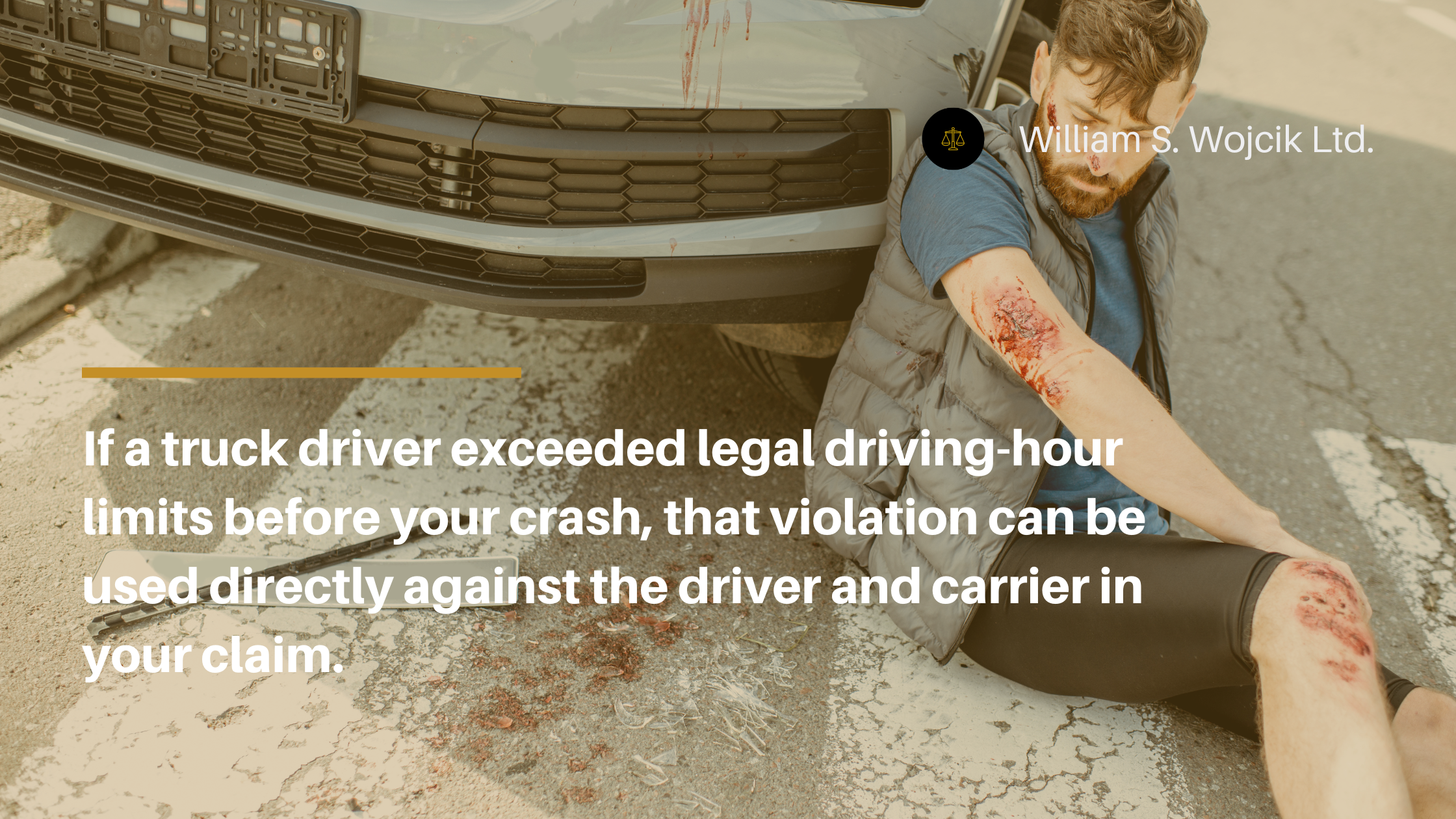
In plain terms: if a truck driver exceeded legal driving-hour limits before your crash, that violation can be used directly against the driver and carrier in your claim.
Evidence Collection for Truck Accident Cases
Commercial trucks generate a paper and digital trail that ordinary vehicles do not. That trail is also subject to being overwritten, deleted, or destroyed; sometimes within days of a crash.
The Electronic Logging Device (ELD) mandate, which took effect in December 2017 and is codified at 49 CFR 395, requires commercial trucks to automatically record driving hours electronically. These records show exactly how long the driver had been on the road before your crash and whether they exceeded legal limits.
Unlike the paper logbooks drivers once filled out by hand, ELD data is difficult to falsify, but it is not retained forever. The full evidentiary record in a trucking case can include the following:
Driver's qualification file
Vehicle maintenance logs
Drug and alcohol testing history
Pre- and post-trip inspection reports
Cargo manifests and load securement records
The carrier's Department of Transportation (DOT) safety rating and Compliance, Safety, Accountability (CSA) scores
The truck's electronic control module (commonly called the black box) which captures speed, braking, and engine data at the moment of impact.
Federal regulations set minimum retention periods for these records, but those periods are not indefinite, and they do not protect records that are overwritten in the ordinary course of business.
A "legal hold demand" is a formal written notice sent to the carrier and its insurer requiring them to preserve all relevant evidence. Sending one promptly after a crash is one of the most important early steps in a trucking case, and it is not something an unrepresented victim has a practical way to do on their own.
If you need help collecting evidence, or have trouble navigating against insurance companies, you can speak to a semi-truck accident lawyer today.
Be Wary Before Accepting Insurance Settlements
Commercial motor vehicles are required to carry substantially more liability coverage than private passenger vehicles.
Under 49 CFR 387, motor carriers transporting general freight must maintain a minimum of $750,000 in liability coverage. For hazardous materials, that floor rises to $5,000,000. These minimums reflect the scale of damage a vehicle weighing up to 80,000 pounds can cause at highway speeds.
Injuries in serious trucking crashes frequently include traumatic brain injuries, spinal cord damage, multiple fractures, long-term disability, and wrongful death, losses that can far exceed what standard auto insurance is designed to cover.
Higher policy limits do not mean the money flows easily. Carriers employ experienced claims teams whose job is to minimize payouts.
An early settlement offer from a carrier's insurer, especially one that arrives in the first days after a crash, is not an act of goodwill. It is a business calculation made before your injuries are fully documented, before liability has been investigated, and before anyone knows what the case is actually worth. Accepting it closes your claim permanently. Once signed, there is no going back regardless of how your injuries develop.
The Filing Deadline in Illinois
Illinois gives injured victims two years to file a personal injury lawsuit.
735 ILCS 5/13-202 requires personal injury actions to be filed within two years of the date the injury occurred. Wrongful death claims follow a separate statute, 740 ILCS 180/2, which runs two years from the date of death rather than the date of the crash itself.
Two years can feel like a long window until you account for what actually has to happen before a trucking case is ready to file: identifying all defendants, sending evidence preservation demands, gathering and analyzing federal regulatory records, obtaining ELD data, consulting with accident reconstruction or medical experts, and fully documenting the scope of your injuries and losses.
In practice, waiting significantly reduces your options.
What to Do After a Semi-Truck Accident in Illinois

Below is an outline of the steps we encourage you to take in chronological order:
Your first priority is medical care. Go to the emergency room or urgent care even if you feel relatively okay. Some of the most serious injuries from high-force collisions, including traumatic brain injuries and internal bleeding, do not produce obvious symptoms immediately. A medical record created on the day of the crash establishes a baseline that becomes important evidence later.
Follow through on all recommended follow-up care. Gaps in treatment are one of the first things defense attorneys use to argue that your injuries were not as serious as claimed.
Document everything you can access at the scene. And in the days that follow. Take photographs of both vehicles, the road, any skid marks, the truck's license plate and DOT number, the driver's Commercial Driver's License (CDL), and any visible injuries.
Get the names and contact information of witnesses. Write down your own account of what happened as soon as you are able, while the details are still clear. If the police responded to the scene, obtain a copy of the crash report. These materials form the foundation of a claim before any formal investigation begins.
Do not speak with the trucking company's insurance adjuster without legal representation. Adjusters are trained to gather statements that can be used to reduce or deny your claim. You are not required to give a recorded statement, and doing so early(before you know the full extent of your injuries or understand who is liable) can significantly harm your position. The same applies to signing any documents, including medical records releases that go beyond your treating providers.
Talk to a Chicago Truck Accident Lawyer
Wojcik Law represents individuals injured in semi-truck and commercial vehicle accidents throughout Illinois, with offices serving Chicago and the southwest suburbs.
For additional information on the cases we’ve worked through over the years, you can read about them here.
You can schedule a consultation to review your situation, explain your rights, and discuss whether a formal investigation makes sense given the circumstances of your crash. Alternatively, you can reach us at 708-424-2121. There is no fee unless your case results in a recovery.