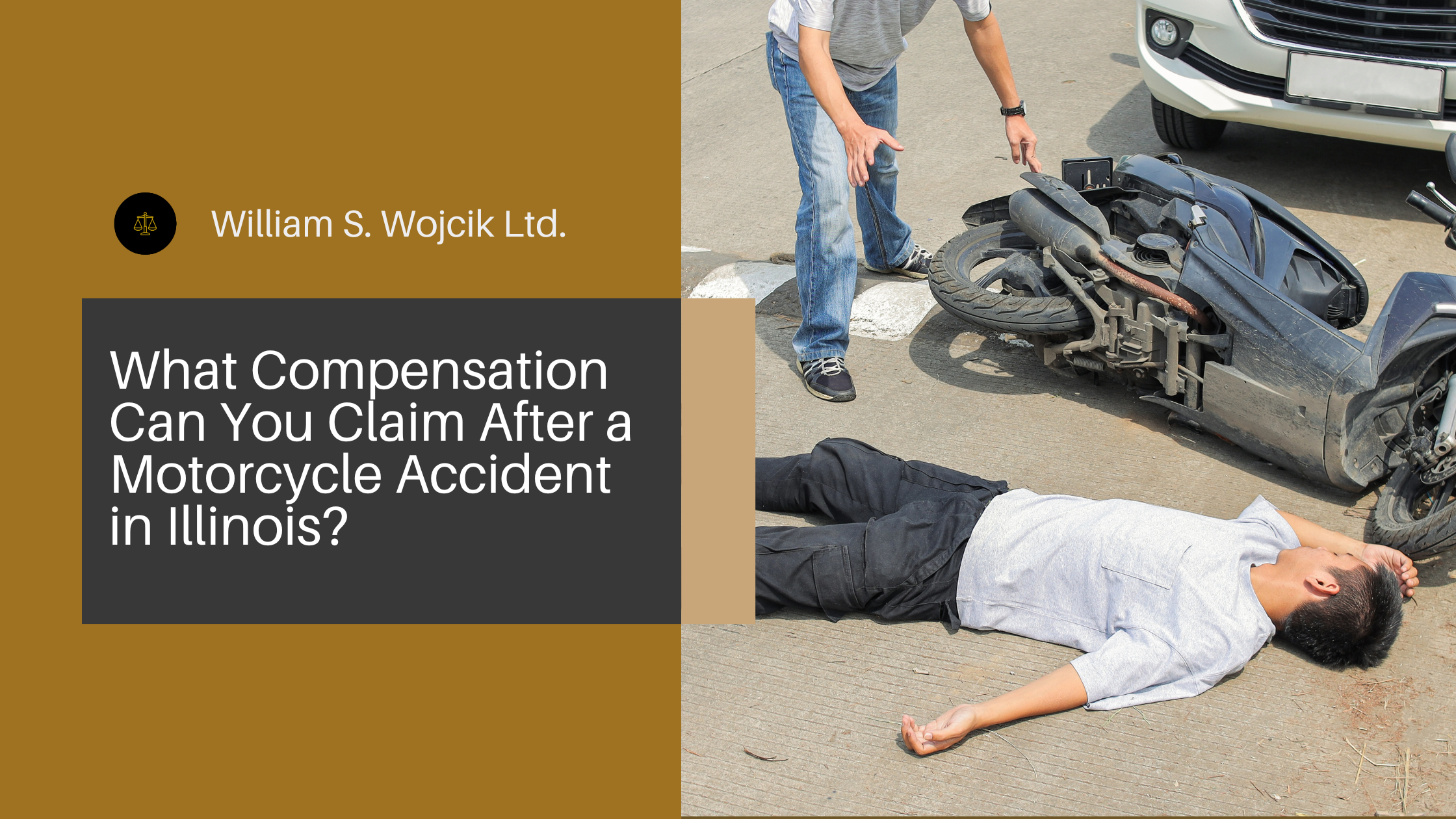
Illinois recognizes three categories of compensation for a motorcycle accident:
Economic damages for documented financial losses
Non-economic damages for personal harm, and;
Punitive damages.
Knowing what motorcycle accident compensation Illinois law entitles you to, and what affects how much you can recover, is the first step toward protecting your motorcycle injury claim.
This guide covers each one and the Illinois-specific rules every rider should understand before walking into any motorcycle accident settlement discussion.
The Types of Compensation in a Motorcycle Accident Case
Illinois personal injury law divides motorcycle accident compensation into three distinct categories. Each serves a different purpose, and understanding the difference matters when your claim is being evaluated by an insurer or a court.
Economic damages: your documented financial losses
Economic damages, also called special damages, cover the financial losses that can be calculated from bills, pay stubs, receipts, and records.
Illinois places no cap on economic damages in personal injury cases, meaning there is no arbitrary limit on what you can recover for documented losses.
Common economic damages in a motorcycle injury compensation claim include:
Surgeries
Hospital stays
Follow-up treatment
Medical expenses covering emergency care
Lost wages for time missed from work during recovery
Projected future medical costs if ongoing rehabilitation is required
Motorcycle repair or replacement along with damaged protective gear
Lost earning capacity if the injuries permanently affect your ability to work at the same level
Out-of-pocket expenses such as transportation to appointments or home modifications for mobility.
The more thoroughly you document these losses from day one, the stronger the foundation of your motorcycle injury claim.
Non-economic damages: Intangible, subjective losses
Non-economic damages, sometimes called general damages, compensate for intangible losses such as emotional distress or loss of enjoyment from life.
Like economic damages, Illinois places no cap on non-economic damages in motorcycle accident cases either. A pain and suffering settlement accounts for the physical discomfort, emotional distress, anxiety, and disruption to daily life that serious injuries produce.
Additional non-economic damages include:
Loss of enjoyment of life
Permanent disfigurement or scarring
Loss of consortium; the legal term for the impact the injuries have had on a spousal or partner relationship.
Because these damages are subjective, attorneys typically use one of two approaches to calculate them.
The multiplier method applies a number between 1.5 and 5 to total economic damages based on injury severity.
The per diem method assigns a daily dollar value to the pain and suffering settlement for the full duration of recovery.
Neither produces a guarantee, but both give your claim a documented, defensible basis.
Punitive damages: when the court goes further
Punitive damages, also referred to as exemplary damages, are designed to punish the at-fault party for conduct that was willful and wanton, meaning deliberate or recklessly indifferent to the safety of others.
Think of punitive damages as a legal recompense where the defendant is guilty of offense, or committing wrong/neglectful behavior.
In motorcycle accident cases, the most common scenario involves a drunk driver.
If the at-fault driver was intoxicated and that conduct directly caused your injuries, punitive damages may be available on top of your motorcycle accident compensation.
These are not a factor in most motorcycle crash claims, but they are worth discussing with an attorney when the circumstances of the accident were especially serious.
What factors determine how much you can recover?
No two motorcycle accident settlements produce the same outcome. The total motorcycle accident payout available in your case depends on several factors working together.
Severity
The severity and permanence of your injuries have the most direct influence.
Grave serious injuries produce higher medical costs, longer recovery timelines, and greater impact on your earning capacity.
Insurance Coverage
The at-fault driver’s insurance coverage limits shape the ceiling of what their insurer will pay, regardless of how large your damages are.
Evidence Strength
The strength of the evidence supporting a pain and suffering settlement also plays a role. Documented medical records, expert testimony, and a clear injury timeline all contribute to a stronger position.
How Clearly Fault is Established
How clearly fault can be established affects both the likelihood of a fair motorcycle accident settlement and the final compensation for motorcycle accident losses you can pursue.
How Illinois comparative negligence law affects your claim
This is the area of Illinois law that insurance companies apply most strategically against motorcycle riders, and understanding it clearly is essential before entering any negotiation over motorcycle accident compensation in Illinois.
Under Illinois’s modified comparative negligence statute, 735 ILCS 5/2-1116, an injured rider can still recover compensation even if they were partly at fault, as long as their share of fault does not exceed 50%.
If a rider is found to be more than 50% responsible for the accident, they are barred from recovering any compensation. At 50% fault or below, recovery is still available but reduced proportionally.
To make that concrete: if your damages are valued at $100,000 and you are found to be 30% at fault, your recoverable compensation is reduced to $70,000.
The practical problem is that insurers know this statute and use it deliberately. After a Chicago-area motorcycle accident, it is common for an insurance adjuster to claim the rider was speeding, following too closely, or lane-splitting, which is prohibited in Illinois under 625 ILCS 5/11-703(c).
These arguments are designed to shift a larger share of fault onto the rider and reduce the motorcycle injury claim accordingly, often without adequate evidence to support them.
Having legal representation during this stage changes the dynamic considerably. An attorney familiar with how motorcycle accident compensation in Illinois is calculated under comparative negligence rules can challenge unsupported fault allegations and ensure that the insurer’s account of the accident is grounded in actual evidence, not assumption.
Read more about what to do after a motorcycle accident in Illinois
What if the at-fault driver had no insurance?
If you carry uninsured motorist coverage (commonly abbreviated as UM coverage) on your own policy, you can pursue compensation for a motorcycle accident caused by an uninsured driver directly through your own insurer.
This applies when the at-fault driver has no insurance or cannot be identified, as in a hit-and-run. Underinsured motorist coverage, or UIM, works similarly: it covers the gap when the at-fault driver’s policy limits are too low to fully cover your motorcycle accident settlement.
Illinois requires insurers to offer UM/UIM coverage, though riders are not required to carry it.
Illinois also sets minimum liability requirements at $25,000 per person and $50,000 per accident for bodily injury. In a serious motorcycle crash claim, these minimums are frequently exhausted before all losses are covered. Reviewing your policy before any settlement discussions is a reasonable first step.
Does not wearing a helmet affect your compensation?
Illinois is one of only three states with no helmet requirement for adult riders.
Adults operating or riding a motorcycle are not legally required to wear one, though protective eyewear is required unless the motorcycle is equipped with a windshield.
The absence of a helmet does not automatically reduce your motorcycle accident payout or undermine your position, but it can become relevant depending on the nature of your injuries.
If your injuries are unrelated to the head, such as fractures, spinal damage, or road rash, helmet use is generally not a factor in your claim.
If you sustained head or facial injuries and were not wearing a helmet, the defense may argue that you contributed to the severity of those specific injuries, which could affect the comparative negligence calculation for that portion of your damages.
This is worth raising early with an attorney rather than assuming your position is weakened. The nature of the injuries and the circumstances of the accident determine whether helmet use is legally relevant, not the absence of a helmet on its own.
How long do you have to file a motorcycle accident claim in Illinois?
The Illinois law, 735 ILCS 5/13-202 statute gives injured riders two years from the date of the accident to file a personal injury lawsuit.
Missing this deadline allows the defendant to request dismissal, and courts enforce it without exception. This statute of limitations applies to lawsuits, not insurance claims, which carry their own shorter reporting windows. Even so, waiting weakens your motorcycle injury compensation claim regardless of which route you pursue.
The longer you delay, the faster evidence deteriorates, witness recollections change, and medical records become harder to connect directly to the accident.
Starting the process early keeps your motorcycle accident settlement options open and gives your attorney the clearest possible picture of what happened. If you were injured in a motorcycle accident in the Chicago area, a conversation with an attorney while the details are still fresh is the most straightforward step you can take.
Consult With a Motorcycle Accident Lawyer at Wojcik Law
At Wojcik Law, we work with motorcycle accident victims throughout Chicago and Cook County to evaluate their claims, understand what motorcycle accident compensation Illinois law provides, and navigate the process with clarity.
Scheduling a consultation is a reasonable first step toward understanding where you stand.