Motorcycle vs. car accident claims in Illinois run on the same legal framework, but three things set them apart:
How severely riders typically get hurt,
How much unspoken bias insurers and juries can carry against them, and;
How closely fault gets scrutinized.
Motorcyclists often face more serious injuries, which raises what a claim is actually worth. At the same time, insurers sometimes assume a rider was being reckless before they know any facts, and Illinois's comparative fault rule means that assumption can directly reduce a payout.
A Chicago motorcycle accident attorney at Wojcik can help counter those assumptions, handle communication with insurers, and pursue the compensation you're owed. Here's exactly where the two claim types diverge.
How Motorcycle Accident Claims Differ From Car Accident Claims
One of the biggest differences between motorcycle and car accident claims lies mostly in the process:
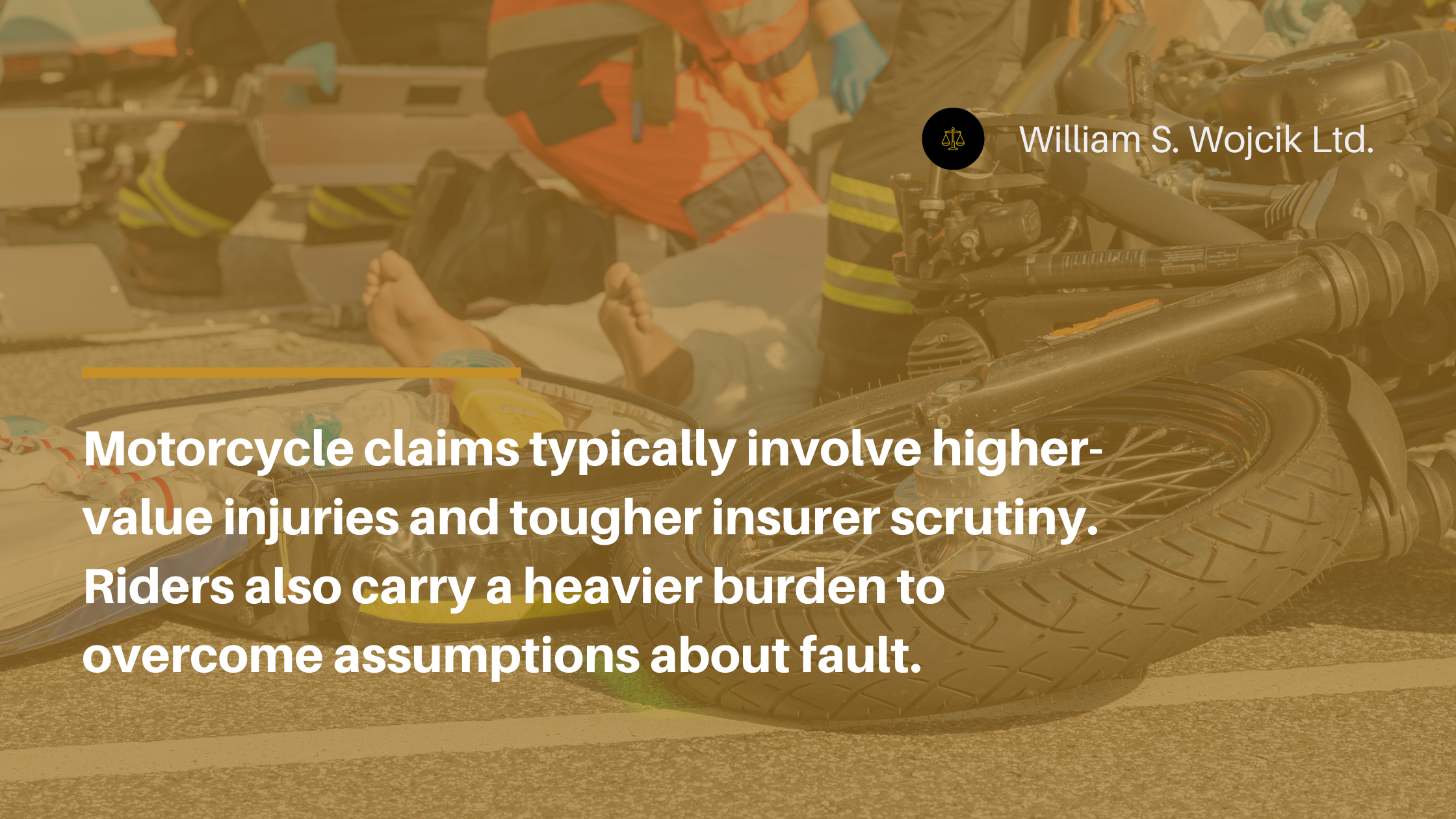
Motorcycle claims typically involve higher-value injuries and tougher insurer scrutiny. Riders also carry a heavier burden to overcome assumptions about fault.
Car accident claims tend to move through a more predictable process. The vehicle’s structure does a lot of the “explaining” for how the injuries happened.
The core legal rules are the same for both claim types: negligence, comparative fault, insurance minimums.
What changes is how insurers and juries apply those rules once a motorcycle is involved. A rider has no windshield, no airbag, no door panel absorbing the impact. The same crash leaves a very different injury behind for a rider than it would for a driver.
For a quick overview of their differences, you can refer to the table below:
| Key Differences | Motorcycle Accident Claims | Car Accident Claims |
|---|---|---|
| Legal framework | Same core rules: negligence, comparative fault, insurance minimums | Same core rules apply |
| Injury severity | Riders are about 5x more likely to be injured and nearly 27x more likely to die per mile traveled (NHTSA, 2024) | Vehicle structure, airbags, and seatbelts absorb most crash force |
| Typical injuries | Traumatic brain injuries, road rash, multiple fractures | Injuries generally less severe due to vehicle protection |
| Claim value | Often higher, driven by more serious injuries and longer recovery | More predictable, tracks more closely to vehicle damage |
| Insurer/jury bias | Riders often face an unspoken assumption of recklessness, even when evidence points elsewhere | Rarely starts from an assumption of fault |
| Effect of Illinois comparative fault law | A 10–15% unwarranted bias shift in fault can meaningfully cut a settlement, since damages reduce in proportion to assigned fault (735 ILCS 5/2-1116) | Less exposure to the same bias-driven fault shift |
| State minimum insurance | Same $25,000/$50,000 minimum, but far more likely to fall short given injury severity (Illinois Dept. of Insurance) | Same minimum, more often sufficient |
| What often decides the claim | Strong documentation to counter assumed fault | Vehicle damage typically “explains” what happened |
Sources: National Highway Traffic Safety Administration (2024 crash data); 735 ILCS 5/2-1116; Illinois Department of Insurance minimum coverage requirements.
Understanding those differences early is often the first step.
Throughout this guide, we’ll discuss each difference in depth. If you’re currently in the process of filing for a motorcycle accident claim, a consultation with Wojcik Law can help you see where your claim stands.
Why Motorcycle Injuries Lead to Higher-Value Claims
Motorcycle injuries tend to be more severe than car accident injuries primarily because riders have no structural protection absorbing the force of a crash.
National crash data backs this up.
Per vehicle miles traveled, motorcyclists were almost 27 times more likely than passenger car occupants to die in a motor vehicle crash in 2024, and almost 5 times more likely to be injured, according to the National Highway Traffic Safety Administration. A car’s frame, airbags, and seatbelts absorb and redirect crash energy away from the people inside.
A motorcycle offers none of that protection.
The rider’s body takes the impact directly. That’s why traumatic brain injuries, road rash, and multiple fractures show up far more often in motorcycle claims.
Higher injury severity drives everything else up with it. Medical bills climb. Recovery drags on longer, and lost-wage and pain-and-suffering claims grow larger too.
That also means insurers have more money at stake. And more money at stake means more incentive to dispute liability before they get there.

The Bias Motorcyclists Face That Car Accident Victims Don’t
Motorcyclists often face an assumption of fault that drivers rarely encounter. This happens even when the evidence points the other way.
Attorneys who handle these claims regularly describe a clear pattern:
Riders get more scrutiny, slower responses, and lower initial settlement offers than drivers filing comparable claims.
Insurance adjusters, witnesses, and even jurors can carry an unspoken belief that riding a motorcycle is inherently reckless. So when a crash happens, the default assumption often points toward the rider.
That bias can shape how thoroughly an adjuster investigates the other driver’s conduct. It can also show up as a lowball offer, floated early, hoping you’ll accept before you know your claim’s real value.
But most multi-vehicle motorcycle crashes aren’t caused by the rider at all.
National data shows the opposite pattern. Other drivers turning left in front of a motorcycle, or simply failing to see one, cause most of these collisions. Overcoming that bias usually comes down to documentation.
Photos, witness statements, and a clear account of the crash sequence leave little room for assumption to fill the gaps - steps covered in more depth in our guide on what to do after a motorcycle accident in Illinois.
How Illinois’ Comparative Negligence Law Hits Riders Differently
Illinois follows a modified comparative negligence rule. It bars recovery once a person is found more than 50% at fault.
Under 735 ILCS 5/2-1116, a plaintiff is barred from recovering damages if the trier of fact finds their contributory fault is more than 50% of the proximate cause of the injury. Below that line, damages get reduced in proportion to the plaintiff’s share of fault, not eliminated entirely.
Here’s a typical scenario we see motorcyclists face:
Say bias pushes an adjuster, or later a jury, toward assigning 10-15% more fault to a rider than the facts support. That shift alone can mean the difference between a full recovery and a much smaller one. A car accident victim rarely has to fight that same uphill battle just to get a fair starting percentage.

For a rider, disproving an assumption is often the first job before the real negotiation over damages even begins.
This is where a well-documented account of the crash carries extra weight. The evidence has to do more than show what happened. It has to actively counter a bias the reader, adjuster, or juror may not even realize they’re bringing to the file.
Insurance Coverage Differences Between the Two Claim Types
Illinois requires the same minimum liability coverage for motorcycles as it does for cars. But that minimum stretches much further in a car accident than it does in a motorcycle accident.
Illinois law requires drivers and riders alike to carry bodily injury liability coverage of at least $25,000 per person and $50,000 total per accident, per the Illinois Department of Insurance.
They fall short fast in motorcycle claims. though.
A broken bone from a low-speed fender bender might stay within a $25,000 limit. A traumatic brain injury or complex fracture (the kind of injury far more common for riders) routinely exceeds it.
When the at-fault driver’s policy limit isn’t enough, uninsured/underinsured motorist (UM/UIM) coverage on the rider’s own policy becomes the next line of recovery. Reviewing that coverage early is worth doing, before a claim even reaches negotiation, for either a motorcycle accident or a car accident claim.
What This Means for Your Claim in Chicago
Riders filing claims in Chicago and greater Cook County deal with the same statewide rules.
But local factors add another layer. Dense traffic, a crowded field of competing insurance carriers, and courts that see a steady stream of motor vehicle injury cases all shape how these claims move.
That volume cuts both ways. Insurers handling Chicago-area claims have well-established playbooks for pushing back. But there’s also a deep body of local case outcomes an experienced attorney can draw on.
A claim that gets litigated, rather than settled, moves through the Circuit Court of Cook County; one of the busiest court systems in the country. That’s one reason motorcycle claims here often benefit from early legal involvement, rather than a wait-and-see approach with the insurance company.
FAQ: Motorcycle vs. Car Accident Claims in Illinois
Does Illinois treat motorcycle accidents differently than car accidents under the law?
No, the same statutes and comparative negligence rules apply to both. What differs is how those rules play out in practice, given higher injury severity and more insurer scrutiny in motorcycle claims.
Why do motorcycle accident claims often settle for more than car accident claims?
Motorcycle injuries tend to be more severe, since riders lack the structural protection a car provides. Higher medical costs and longer recovery periods typically push claim values higher, too.
Do I need a lawyer for a motorcycle accident claim if I wasn’t badly hurt?
Even claims that look minor at first can run into insurer bias or a low initial offer. A brief consultation can help you understand whether the number on the table actually reflects your damages.
Talk to a Wojcik Motorcycle Accident Attorney About Your Claim
Understanding your options is often the first step toward a fair resolution. A consultation with Wojcik Law can help clarify where you stand and what your claim may actually be worth. Browse our full range of case results to see how we handle cases beyond motorcycle and car accidents.